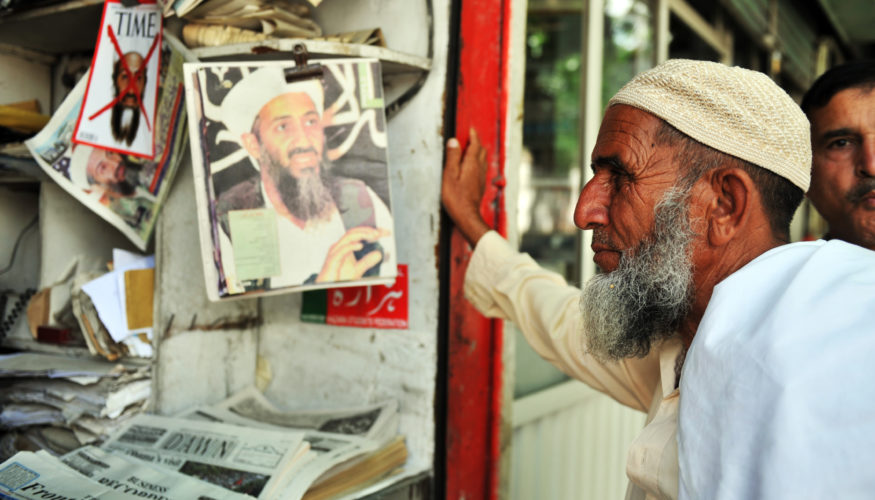
Osama Bin Laden / The Making Of The World’s Most Notorious Terrorist
By Michael Snow
1979 was seminal in world history. The year began with the return to Iran of Shiite leader Ayatollah Ruhollah Khomeini, who established a theocracy that radically transformed Persian society. The message of the Iranian revolution, of a new day dawning in the Middle East, quickly reverberated throughout the troubled region, foreshadowing a huge surge in international Islamic terrorism that undercut the 1979 Egyptian-Israeli peace accords and whet regional appetites for widespread reform. Except for Iran, though, the area’s corrupt, self serving autocratic rulers, if anything, remained more entrenched than ever, exemplified by the ascendancy of Saddam Hussein as president of Iraq that same year. As the ornate palaces of Saddam and other brutal kleptocrats of the region went up, so did unemployment and the souring of hope, which floundered rather than flourished on the shores of globalization. The Soviet invasion of Afghanistan in December 1979 further stoked the anger of the dispossessed, the humiliated and the disenfranchised, who found expression for their pent up rage by taking up arms as anti-Soviet jihadists in South Asia. 1979 was also the year that hundreds of Islamic militants seized the Grand Mosque in Mecca during the hajj, the annual pilgrimage of the faithful, to protest what they viewed as the illegitimate stewardship of Islam’s holiest places by the ruling House of Saud, sustained only by its strange, uneasy, long term alliance with radical Wahhabi clerics. This perfect storm of events sent oil prices soaring. Flush with cash, but threatened by the takeover of the Grand Mosque and the spread of rival Iranian Shiism, the House of Saud and their Wahhabi bedfellows poured huge amounts of petro dollars into a worldwide campaign designed to spread their extremist brand of Sunni Islam through madrasas staffed by firebrand, semi-illiterate preachers whose potent mix of religion and hatred formed the core curriculum. This massive brainwashing, fueled by the forces of globalization, set the stage for Islamists like bin Laden to muscle aside moderates and bestow on their own destructive Islamic absolutism the imprimatur of respectability.
Collective Muslim rage directed by bin Laden and his fellow radicals didn’t arrive in the U.S. until 1993 with the bombing of the World Trade Center that killed six people. But by then the Islamist revolution had picked up steam. By the time of the attacks of September 11, 2001, it had become a juggernaut, powered by what French sociologist Emile Durkheim referred to as" anomie," a type of suicide associated with the loss of a particular way of life or, on a broad scale, the unraveling of traditions practiced for generation that served as the backbone of their societies. The burgeoning populations of many if not most Muslim countries; the preponderance of young, jobless, illiterate, and urbanized migrants in throbbing Muslim cities like Karachi (which had a population of 300,000 in 1947 and today has 15,000,000), Cairo and Kuala Lumpur and the total breakdown of civil society that this portends, not only in Pakistan but elsewhere throughout the Muslim world, has been fruit ripe for picking by bin Laden and his fellow radicals. The dearth of Muslim leadership, Muslim scholarship, and the fact that the combined gross national product of all 22 Arab countries amounts to less than that of Spain[1] made it all the more sweeter.
Invariably, the trail leads back to 1979. The popularity of the 1979 film Time After Time, in which the notorious Jack the Ripper appears in San Francisco at the height of the sexual revolution as civilization teeters on the brink of nuclear annihilation in a sense portends the September 11 calamity. So does the success that milestone year of Apocalypse Now and the Gloria Gaynor tune, I will Survive, which seems to envision the arrival, perhaps by time travel, of a medieval man destined to become infinitely more demonic than Jack the Ripper. But in reality Osama bin Laden was not plucked by a time machine from the dark corners of history. He is simply the product of his environment: the events of 1979 and key people and ideas that came before him. In 1979, they coalesced to set bin Laden, then an impressionable 22-year-old student, on the road to becoming history’s most notorious terrorist. And, because of the forces of Globalization, change the face of world.
Globalization, the gravitation toward a worldwide investment environment and integration of national capital markets, theoretically narrows the gap that powerful nations once enjoyed over small nations. It also helps narrow the advantage that nation states once enjoyed over terrorists by giving them access to a vast technological tool kit, theoretically enabling even a single person equipped with lethal ideas to challenge a superpower. However, globalization can be turned on itself, particularly from those who failed to reap its benefits.[2] Technical changes — the use of more powerful explosives and sophisticated demolition techniques- have simply made it easer to kill large numbers at a time, even while the upsurge in casualties since 1979 in no way represents an increase in the number of active groups, or of attacks.[3] To get a sense of the dramatically enhanced destructive potential increasingly available today, picture some of history’s most notorious rouges with access to the latest technology, transmorgified, miniaturized, and weaponized. Consider Genghis Khan with his own nuclear arsenal instead of horses, bows and arrows. Or Hitler with missiles tipped with anthrax and botulism rather than shower caps that sprayed Zyklon B. Think about how Pol Pot or Idi Amin might have put cell phones, PCs, email and other tools of the global age to demonic use. Add to the mix religion, and religious zealotry in particular, and you have at your fingertips an ultra powerful recipe for cataclysm. So, in a sense, globalization made time travel real, for better or worse. While it brought huge benefits to India and China and many other parts of the world, it also made possible the creation of real Frankensteins eager to butt heads.
Carlos the Jackal, the Baader Meinhoff Gang and the Shankhill Butchers of Northern Ireland all wreaked havoc during the 1960s and 70s while "mad bomber" George Matesky terrified New York City from 1940 to 1956.[4] Imagine how much more lethal these terrorists could have been if they had come of age 20 years later privy to the tools of globalization that Osama bin Laden now has at his fingertips. Princeton historian Samuel Huntington attributes the growing discord between the Moslem and non-Moslem world and what appears to be a propensity toward terrorism to what he calls a "clash of civilizations."
Many in the West see Islam as a single bloc with al Qaeda as its voice, when in fact Osama bin Laden and likeminded radicals who comprise this fringe group constitute only a tiny part of the Islamic community worldwide, with leadership that numbers perhaps no more than 100 or 200; the Wahhabism that forms its spiritual cornerstone, perhaps no more than five percent of all Muslims. But the asymmetrical power made possible by globalization and fueled by U.S. missteps in Iraq has leveled the playing field and empowered this relatively small group with clout hugely disproportionate to its actual numbers. This often affords the false impression that most Muslims subscribe to bin Laden’s revolution at the same time managing to convince many Muslims themselves of an obligation to support it. According to Bernard Kaykel, professor of Middle Eastern Studies at New York University, three historical factors have aided the rise to prominence of bin Laden and other Salafi-Wahhabi self-styled holy warriors. They include the:
1) Co-option by repressive states throughout much of the twentieth century of moderate Islamic scholars to provide Islamic justification for unpopular policies that cost the moderates their credibility.
2) Political and economic failure of the secular nationalist policies of most Arab states, together with their strong-armed authoritarianism, have led to mosques — now dominated by a younger and more militant generation of Islamists — to become the only centers of opposition to regimes in power.
3) The inability of financially strapped traditional centers of Islamic education to recruit or educate dynamic scholars has by default allowed Salafis and the cash-rich authoritarian regimes that dominate the Muslim world to impose their radical agenda.[5]
Such piracy might be referred to as "hijackulation," the hijacking and impregnation of fringe ideas into a civilization through a mix of terrorism, religion and nationalism capable of conferring broad respectability on a radical cause. In this context, to Western eyes, bin Laden has become the perfect Frankenstein monster.
But on a personal level bin Laden appears to be no monster, just the most plausible candidate for super villain status. The notion of a global terrorist mastermind is vastly exaggerated.[6] After all, Bin Laden’s al Qaeda movement resulted from unification of three or more preexisting terrorist movement, each with vast experience, and any of the unified movement’s senior leaders could probably provide comparable leadership. Important Questions remain unanswered: How centralized is al Qaeda? Are terrorist acts claimed by the group actually the handiwork of decentralized units? Regardless, in both news accounts and popular fiction since the mid-1990s, Osama alone has represented the abhorred face of terror, the absolute head of a uniquely evil empire.
Who is Osama bin Laden, and what made him into a modern day Frankenstein. Or, for that matter, is he really a Frankenstein at all?
There is no evidence that he endured abuse as a child or tortured small animals and birds, and no accounts of him launching into psychotic rages. In fact, contrary to his monstrous image in the west, he is anything but Frankenstein. According to his closest Muslim associates and many of the Westerners who have interviewed him, he appears to be a genuinely pious Muslim; a devoted family man; a talented, focused, and patient insurgent commander; a frank and eloquent speaker, a successful businessman; and an individual of conviction, intellectual honesty, compassion, humility, and physical bravery, genuinely repulsed by what he believes has been gross exploitation by the U.S. of Moslems and Muslim lands, as well as what he sees as the American propensity to prop up autocratic rulers throughout the region who, in turn, ruthlessly exploit their native populations. Defeat by Israel and its mistreatment of Palestinians is an ongoing sore point with bin Laden as it is with the vast majority of Muslims. But bin Laden has been particularly incensed by the stationing of U.S. troops in Saudi Arabia, the "land of the two Holy Mosques," prior to the Gulf War. By all accounts, bin Laden is smart, though not an original thinker. But, like Saddam, he sees himself as something of a modern day Saladin, giving up all earthly conveniences and bravely taking up the sword to defend Islam against of the evils of the Americans, the Israelis, and other modern day Crusaders. If he had intellectual range of, say, his deputy, Dr. Ayman al-Zawahiri, he might liken himself to Thomas Jefferson, author of the Declaration of Independence, who in essence wrote concerning the British dominance of the U.S. in the 18th century that enough was enough, a line had been crossed, and inaction was no longer tolerable; or John Brown, who after years spent speaking, writing, and working against slavery, declared: "Talk, talk, talk. That will never free the slaves. What is needed is action — action."[7] By the same token, American leaders today might have better luck defeating the war of ideas presented by this terrorist mastermind if they would recognize that many beholders of the status quo considered Jefferson and Brown terrorists of their time.[8]
Muslims are actually relative newcomers to the ideals of revolutionary terrorism, which in the modern world evolved in predominantly Christian countries like Russia, France, and Ireland. Today, Ireland is a peaceful and prosperous nation, but its national political mythology focuses on an act of revolutionary warfare, the urban guerrilla rising launched by Irish nationalists in Dublin in 1916. Eamon De Valera, one of the surviving terrorist leaders of the 1916 uprising, dominated Irish politics into the 1960s, just as former Jewish guerilla leaders such as Menachem Begin did in Israel and Yassir Arafat has in Palestine. Irish terrorist Padraic Pearse uttered words that have become the most famous in Irish history by concluding that "life springs from death; and from the graves of patriot men and women spring living nations."
The Psychology of Terrorism: Public Enemy Number One
Despite these lessons of history, many in the West view bin Laden dismiss as a psychotic, deferring to the sizeable body of literature from the 1970s and 1980s that focused on the pathology of terrorism and the lengthening list of assassins, hijackers and terrorist groups among their ranks. Even the New York Times reinforced this notion, as in a 1986 headline from its science section entitled, "The Roots of Terrorism are found in Brutality of Shattered Childhood." By most standards, bin Laden and his al Qaeda allies appear rational in their methodical attempts to inflict maximum damage against the U.S. Their tactics might appear incomprehensible to some but they serve a purpose: namely, to force the hated Americans to surrender or withdraw.[9] In essence, bin Laden’s motives are the same as any soldier prepared to kill for his people, not for the sake of killing but, as he might put it, so that the coming generation might have a life. He and others cite self defense, or retaliation for previous offenses committed by the authorities of the enemy nation to justify their actions.
Mainstream western opinion invariably questions the morality of terrorist activity, of bin Laden and others, but terrorists themselves look at the issue completely differently. In a telling moment in the classic film, Battle of Algiers, a captured FLN leader, responding to the question of a journalist about why he fights using women who carry bombs in their shopping bags, observed that the French use bomber aircraft against his people’s village, and that he wishes he could fight by such means. Give us your bombers, he says, and we will give you our shopping bags.
"The most important psychological source of terrorism is always the feeling of revenge in search of an outlet," Leon Trotsky wrote in 1909. As bin Laden himself might say of his bloody handiwork: "the worse, the better." The al Qaeda spokesman, Suleiman Abu Gheith, maintained in 2002 that the 9/11attacks served as retribution for previous U.S. crimes around the globe. Many other radical Muslims also viewed those killed in the World Trade Center and the Pentagon as no more than fair exchange for the victims of the Al-Amiriya shelter in Iraq, and a small percentage of those killed in Palestine, Somalia, Sudan, the Philippines, Bosnia, Kashmir, Chechnya, and Afghanistan. "We have not reached parity with them," said Abu Gheith in 2002. "We have the right to kill four million Americans — two million of them children — and to exile twice as many and wound and cripple hundreds of thousands. Furthermore, it is our right to fight them with chemical and biological weapons, so as to afflict them with the fatal maladies that have afflicted the Muslims because of the American’s chemical and biological weapons." [10]
President Bush personally attacked bin Laden and the other perpetrators of 9/11 who share these reprehensible views, but in so doing gave them the kind of attention they craved, since the more publicity a terror group gets, the more effective it becomes in provoking disorder. And, in turn, the more likely it will be to attract followers and supporters — and probably financial support. At the same time, the more a government attacks a group as "evil and dangerous," the better, because visibly alarming a regime leaves a clear impression that terrorists are having major impact. President Bush’s repeated condemnations of bin Laden as Public Enemy Number One following 9/11 made the terrorist leader a household word and further strengthened his political credentials. While violent acts of reciprocity further drove the U.S. to new heights of vengeance, they also escalated tension worldwide, forcing people in many communities to take sides, rendering moderation toothless, and further polarizing society in an escalating cycle of violence.[11]
The elevation of bin Laden and other radicals has been all the easier because of lack of moderate voices among Muslim leaders who reflect the Islamic spirit of egalitarianism and tolerance in plural societies.[12] Mohammed Ali Jinnah, the founder of Pakistan, was such a powerful figure. Jinnah believed in human rights, women’s rights, minority rights, and the rule of the constitution. Both supporters and opponents of Jinnah and the concept of an independent, sovereign Pakistan expressed commitment to Islam, albeit through different channels. Jinnah fought for the rights of Muslims through constitutional means; his Muslim critics demanded confrontation and violence.[13] A brilliant lawyer, he rose to the forefront of the struggle for a Muslim nation as India negotiated its independence from Britain. But his insistence on a separate Muslim state to be carved out of the former British India, a dream first voiced by Muslim poet-philosopher Muhammad Iqbal, earned him many enemies. Amidst the rising tide of ethnic unrest, Jinnah demanded partition of India. Britain, eager to make a clean break with India, finally relented and Pakistan was born. But Jinnah did not live to see development of his fledging country. He died of tuberculosis in 1948, just 13 months after the formation of Pakistan. His vision of a secular government was never fully realized, either, with disputes between religious groups marring much of Pakistan’s brief history. Jinnah’s biographer, Stanley Wolpert, wrote: ‘Few individuals significantly alter the course of history. Fewer still modify the map of the world. Hardly anyone can be credited with creating a nation-state. Mohammad Ali Jinnah did all three.’
But with his death, momentum died, too, as the reigns of leadership, not only in Pakistan but elsewhere throughout the Muslim world, passed from one weak hand to the next. Leadership remains one of the major crisis points that face Muslim society, a problem that affects not only Muslim nations but also their relationship with other countries.[14] Muslim leaders are failing, first, to provide justice (adl) and, second, to create the conditions for the existence of compassion and balance (ihsan) or knowledge (ilm) in their societies. The lack of leadership led to widespread disaffection throughout the Muslim world and, over time, formed a vacuum that by default has fallen to extremists like bin Laden.
Desperate for change, many in the Moslem community sought escape by pointing to the West and Western influences for its shortcomings, singling out the U.S. in particular. They believe that U.S. foreign policy is irretrievably biased in favor of Israel, trigger happy in attacking the poor and ill-defended Muslim countries, rapacious in controlling and consuming the Islamic world’s energy resources, blasphemous in allowing Israel to occupy Jerusalem and deny Palestinian rights, and merciless because of its previous use of sanctions against the Muslim people of Iraq and support of the Muslim world’s absolutist kings and dictators. It makes no different if these perceptions hold no water: they are dogma to bin Laden and countless Muslim sympathizers. Unless the United States accepts that, and that fact that al Qaeda is not a cult or a transient terrorist organization but a methodically constructed enterprise made up largely of smarter, better educated people who are more ethnically diverse and more geographically dispersed, it won’t be able to defend itself.[15]
Even today, many Americans seem unable to distinguish between the regime of Saddam Hussein and al Qaeda. But the U.S. decision to attack Iraq rather than focus on eliminating the more immediate threat posed by bin Laden and his allies illustrates this disconnect at top levels of government. This even extends to top members of the Bush Administration. During Bush’s first week in office, the president’s chief of terrorism, Richard Clarke, urgently requested a Cabinet-level meeting on al Qaeda. He did not get it — or permission to brief the president directly on the threat — for nearly eight months. When deputies to the Cabinet officials took up the subject in April, Clarke, a Republican who has served U.S. presidents, wrote that the meeting "did not go well." Deputy Defense Secretary Paul D. Wolfowitz, Clarke wrote, scowled and asked, "Why we are beginning by talking about this one man, bin Laden." When Clarke told him no foe but al Qaeda "poses an immediate and serious threat to the United States," Wolfowitz is said to have replied that Iraqi terrorism posed "at least as much" of a danger. FBI and CIA representatives backed Clarke in saying they had no such evidence. "I could hardly believe," Clarke writes, that Wolfowitz pressed the "totally discredited" theory that Iraq was behind the 1993 truck bomb at the World Trade Center, "a theory that had been investigated for years and found to be totally untrue." U.S. involvement in Iraq has spread U.S. forces thin, alienated the world community, undermined the American economy, hampered execution of the war on terror, and galvanized support for bin Laden worldwide. [16]
Bin Laden is by all accounts a smart, patient, shrewd businessman, intellectual though at least not by nature an original thinker. But Westerners who believe that money rather than ideas empowers his organization are mistaken. Overwhelmingly, bin Laden’s senior leadership team is experienced, well educated, and drawn from the Islamic world’s urban middle-and upper-middle classes.[17] Bush’s attempt to denigrate bin Laden has dramatically elevated his status among radical elements of the world ulema. But bin Laden’s message had gained traction long before 9/11. In 1998, the editors of Jang, Pakistan’s largest daily wrote that because of the importance Americans attachment to money, they are blind top the fact that "God...has produced saints in Afghanistan to defeat the international imperialist, who would soon put an end to the money-dominated culture. May God help Osama and the Taliban."[18] More than ever, bin Laden’s message resonates throughout Pakistan and much of the Muslim world. "Many people don’t believe simply don’t that bin Laden was responsible for 9/11," according to Pakistani journalist Saifuddin Saif, who added that no Muslim group or power would have had the technical or organizational skill to carry out the attacks. The Americans themselves might be to blame, he suggested. But the Israel Mossad may have also participated, he continued, because the Israelis, motivated by their wish to drive a wedge between Americans and Arabs in order to establish complete sympathy for the Israeli cause provoke a war between the U.S. and radical Muslim nations, including Afghanistan and Iraq. Mossad thus launched the September plot, careful to pass a warning to American Jews. "On the morning of the attacks — so the legend goes — four thousand Jews stayed away from their normal place of work in the World Trade Center," according to Philip Jenkins. "The story gained support among American radicals and black nationalists. In 2002, New Jersey’s Poet Laureate Amiri Baraka created controversy when he read a poem giving credence to the tale that "’Somebody Blew Up America’"[19]
Who knew the World trade Center was gonna get bombed
Who told 4000 Israel workers at the Twin Towers
To stay home that day
Why did Sharon stay away?
Jenkins added: "The most important point in analyzing the Mossad story is that it is no more than that, a story, which derives from no source or authority that has proved to be reliable in the past. In fact, it is far from clear what the source is, apart from the wishful thinking of some Muslims who wanted to divert the blame from their own people."[20]
This sort of rationalizing may be no more simplistic than the individual Western focus on bin Laden as a kind of popular therapy for a public alarmed at waves of authentic terrorist incidents, for which there seems no imaginable solution. "The message from popular culture is that the problem is chiefly the work of a handful of very evil individuals, and understanding this menace is perhaps less difficult than comprehending the diverse factors (political, social, economic, spiritual) which drive the faceless terrorists of real life. Terrorism can thus be personalized in the form of Carlos, Colonel Qaddafi, or Osama bin Laden. Once such an individual has been identified, he can be fought, defeated, and captured, by whatever means are appropriate."[21]
When digesting such views, so diametrically at odds with those of the West, it is important to take into account the role of Saudi petro dollars and the seeds of hatred that they sowed that laid the groundwork for this widespread receptivity.
Bin Laden is the product of his environment, of an education system rife with rote learning programmed in every way by a Wahhabi theology as austere as barren as Saudi Arabia itself. Since the shock of 1979, when Khomeini ousted the Iranian monarchy and Saudi fundamentalists tried to repeat that feat by taking over the Grand Mosque, the ever-nimble House of Saud has relentlessly hedged its bets, ostensibly cozying up to the United States and the West while pandering to radical clerics at home who impose on the local population the dogma of intolerance and edicts that require strict adherence to sharia. While Saudi princes themselves womanize, drink to excess, and engage in other objectionable pursuits that could cost ordinary subjects their heads, Saudi rulers dispense what amounts to huge outlays of protection money to divert the attention of radical fundamentalists elsewhere. Money supposedly earmarked for charitable Islamic causes often has ended up supporting terrorism, first in Pakistan and Afghanistan, then worldwide. Since 1979, Saudi largesse, either directly or indirectly, has financed countless radical causes: The nightmarish Taliban, which provided the critical base for al Qaeda; suicide bombing campaigns in Israel; and, among others, jihadist struggles in South Asia and Eastern Europe. Much of the recent Muslim-Christian bloodshed in West Africa resulted directly from Saudi pressure on local Muslim officials to impose Islamic law in their territories, a policy so generously funded that it easily overshadowed complaints about human rights violations stemming from it. A case in point is Sudan, which even turned a blind eye to bin Laden’s first guerilla training camps before huge international pressure finally forced his expulsion. Another favorite target has been the United States, where Wahhabi dominated mosques have sprouted up everywhere and now comprise most Islamic houses of worship. Even more insidious, an unspecified amount of Saudi funding has gone to finance charities that have been directly associated with terrorism.
The U.S. view of the Saudis now stands in sharp contrast to the time not long ago when it enjoyed "special relationship" with the kingdom. U.S. intelligence officials actually knew about Saudi Arabia’s role in funding terrorism by 1996, yet for years Washington did almost nothing to stop it.[22] Examining the Saudi role in terrorism, a senior intelligence analyst says, was "virtually taboo." Even after the embassy bombings in Africa, moves by counterterrorism officials to act against the Saudis were repeatedly rebuffed by senior staff at the State Department and elsewhere by those who felt that other foreign policy interests outweighed fighting terrorism. Meanwhile, Saudi largess encouraged top U.S. officials to look the other way, some veteran intelligence officers say. Billions of dollars in contracts, grants, and salaries have gone to a broad range of former U.S. officials who had dealt with the Saudis: ambassadors, CIA station chiefs, even cabinet secretaries.[23] All of this, directly or indirectly, fueled bin Laden’s vehement anti-Western campaign. But at the core was the terrorist’s homeland, Saudi Arabia.
Saudi Arabia: From Boom to Bust
Starting with the 1973 Arab oil embargo and the rising price of crude, this deeply traditional and largely ignored country on the Arabian peninsula catapulted into world prominence, struggling to define itself while trying to cope with an influx of enormous wealth and the arrival of legions of foreigners. "There hasn’t been a rags to riches story like that since the Crusades awakened Europe from the Dark Ages and Venice, Genoa, and Florence became suddenly wealthy from Middle East trade," wrote American journalist Sandra Mackey, who reported secretly about the kingdom from 1980 to 1984 after she and her husband, an Atlanta physician, joined the flood of expatriates contracted to jump start the vast desert nation into the 21st century. Despite the building boom that began in the early 1970s, the age-old Bedouin spirit remained as deeply entrenched in the Saudi soul as religion does in every aspect of Saudi life. Saudis are the puritans of the Muslim world, followers of Wahhabism, the most fundamental, rigid, and intolerant sect in Islam. And Wahhabi Religious figures wield enormous — though not necessarily enlightened — influence. Before his death in 1999, Sheikh Abdul Aziz Ibn Baz, the kingdom’s most revered Imam, remained firm in his conviction that the sun revolves around the earth. The ruling House of Saud, "the guardian of the two holy places," has tied itself inexorably to religious fundamentalists. "There is no but God," reads the Arabic inscription on the Saudi flag. All government documents begin with the phrase, "In the name of Allah, the Compassionate, and the Merciful." Wahhabism follows Hanbali law, the smallest, most conservative, and most radical branch of Islam, which profoundly perhaps no more than 5 percent of the world’s Muslim population. In the world of Wahhabism, Shiities are inferior and non-Moslems, infidels; matawain patrol the streets, camel whips at the ready, to punish even the most minor religious transgressors such as women whose flowing burqas expose even instantaneously the briefest glimpse of flesh. But even very minor offenses can land offenders in the slammer, particularly foreigners, who are typically treated with disdain accorded to this "servant class."
"There is an arrogance among the Saudis that comes from a profound belief in their own superiority," wrote Mackey. "This self-perception has little to do with immense wealth but rather extends back through the centuries when the vast majority of them lived within the confines of family and tribe, experienced nothing of the outside world, and remained smug in their puritanical religion and their ability to survive the harshness of the desert. In The Saudis, Mackey describes a highly sensitive, super secret society that trusts no one beyond family member or tribe and regards women as breeding stock. As late as the 1940s, zealous tribes of the Hadraumaut killed infidels who ventured too close. Saudi Slavery ended only in 1962, five years before the first paved road connected the country’s two main cities, Jeddah and Riyadh. Public beheadings are carried out regularly after Friday services, including that in July 1977 of Saudi princess Mishall bint Fahd for adultery, which inspired the made for TV film, Death of Princess. In 1970, only about 40 percent of all employed Saudis worked in jobs even remotely associated with a modern economy. But even after modernization they shunned many jobs either because they felt them beneath their dignity or because the religious bent of the Saudi school system kept them from learning practical skills. Illiteracy amounted to seventy percent of the population, but only 13 percent could be considered "educated."
Although Saudi Arabia managed to escape foreign domination, the nation in a sense finally became colonized during the oil boom as a result of globalization. Rather than assuaging the painful transition to modernity, the fountain of black gold that gushed from beneath the scorching desert sands exacted a price that ultimately led to the cultural seduction of the society and the breakdown of domestic political institutions, disrupting family life and corrupting the devout. By giving up that which was secure and predictable, the Saudis achieved nearly a decade of unbridled prosperity. But, like a Roman candle, the bonanza, starting in about 1981, began to fizzle. As the oil boom waned, the House of Saud came under increasing criticism from religious conservatives and those unable to participate. The Iranian revolution and the takeover of the Grand Mosque suggested its expendability. Fearful of the future, and ever eager to shore up their legitimacy in the eyes of the influential Wahhabi overlords, the royals meted out more lavish government grants to religious schools, not only at home but throughout the world, especially in Afghanistan and neighboring Pakistan, where many of the unemployed became fodder for jihad.
But the emphasis on religious education only compounded social problems, both at home and abroad, as unskilled graduates found work increasingly difficult to come by and, increasingly, became more alienated. It became a parallel world. In Afghanistan, young madrasa graduates who lacked skills to meet real world demands joined the Taliban. In Saudi Arabia, indoctrination, unemployment and a sense of deprivation warmed those unable to find a place in the system to bin Laden’s message and, eventually, to that of al Qaeda.
Meanwhile, the Saudi birthrate jumped, from seven million to nineteen million since the heyday of the oil boom. In that same time frame, oil revenues in the kingdom shrunk from $227 billion to an estimated $49.6 billion and per capita income fell from $28,600 in current dollars to below $8,000. Those pursuing religious studies climbed to 50 percent, but graduates no longer had carte blanche to standard government jobs that provided comfortable salaries for a four-hour workday, interspersed with frequent tea breaks. The kingdom’s once fabulous infrastructure, constructed during the boom, began to crumble, and today the country remains utterly reliant on foreign workers, who constitute perhaps 90 percent of the private-sector and 70 percent of the public-sector labor force. Drugs, guns, and crime began to appear in the puritanical society for the first time. Sixty percent of the population today is under the age of twenty. Growing dissatisfaction over the issues of authoritarianism within the political system, management of national wealth, inequity in the economy, and the seemingly permanent presence of U.S. military forces that began with the 1991 Gulf War is as broad and deep as is popular support for bin Laden.
The Early Years
The desertscape of bin’s Laden’s early years had no room for weighty texts by the world’s great masters. His exceptionally devout dad, a brilliant but illiterate businessman who signed his name with an "X" and fathered 52 children, did not instill in Osama appreciation of a world class literature and appreciation of a free press that might have helped him contextualize the black and white mantra propounded by charismatic religious zealots. During Osama’s youth, his father frequently arranged halaqat, religious gatherings, which drew the greatest preachers, scholars, and movement leaders of the kingdom for theological discussions.[24] Thanks to these and other influences of his immediate environment, and the Saudi education system, the young Saudi’s mind filled with cookie cutter thoughts about the evil of Christians, Jews, the U.S., Israel, and other demonized Western entities blamed for the humiliation and deprivation of Moslems.
As he grew older, Osama intellectually justified his predisposition for extremist ideology by marshalling and assimilating the ideas of radical Islamist philosophers, singling out for criticism autocratic, repressive Middle Eastern governments that rose to power illegitimately, often with the help of the West. After fashioning al Qaeda, he relied on the media to fan the flames of his pent up rage to a worldwide audience. A natural born publicist with a personal touch, he deftly spread his fervor by releasing precisely timed video tapes through al-Jazeera, CNN and other news organizations that fueled Moslem anger, sprinkling in enough religious dogma to give his diatribes resonance. Before 1979, when CNN was just a fledgling operation and al Jazeera perhaps only a pipedream, bin Laden would have mustered nowhere the support he enjoys today. But the new accessibility of the media and other tools of globalization immeasurably extended his outreach.
The immense wealth accrued in the building business by Mohammad bin Laden gave Osama and his many siblings a huge head start over their peers. Like other Saudi youths, he came under the spell of Safar al-Hawali, a renowned Wahhabi preacher with an open checkbook provided by the ruling House of Saud to mainstream his radicalism. Osama is said to have made his first contact with fundamentalist groups at age seven.[25] His radical religiosity became entrenched after his father landed contracts to rebuild the historic mosques at Mecca and Medina. But the available information about his youth is sketchy and sometimes contradictory. Some reports insist that the youthful bin Laden enjoyed the company of young women and frequented Lebanese night clubs in pursuit of them. During a bucolic summer at an Oxford language school, for example, he and his brothers befriended a group of Spanish girls and took them punting on the Thames. An online photo exhibited by the BBC shows newspaper shots of the girls — one in hot pants — and the bin Laden boys. Osama, wearing flares, a short-sleeved shirt and a bracelet, looks like any other awkward teenager.[26]
Carmen bin Laden, wife of younger brother, Yeslim, wrote in Inside the Kingdom, her recent best selling book published in France, that the first time she met Osama he turned away in disgust on encountering her unveiled face. This was perhaps symbolic of the way he repudiated his earlier alleged flirtations, turning away from what he viewed as the profligacy of the West and toward revolutionary Islam that began to gain traction in the 1970s.[27] But bin Laden’s innate radicalism never appeared to find real expression until he enrolled at King Abdul Aziz University in Jeddah, a magnate for Islamic dissidents from all over the Muslim world. There he fell under the spell of revered radical theologians of the past, including Tammiyah and Sayyid Qutb, and some of his own professors, many of them on the lam from various Middle Eastern nations for their involvement in the radical Muslim Brotherhood, plus others who sought spiritual nourishment in the radical Saudi heartland. Among them was Abdullah Azzam, a fiery Palestinian theologian with a doctorate in Islamic law who was born in Palestine in 1941. Bin Laden proved a rapt follower. More subtly, Osama’s affinity for the teachings of Ibn Tammiyah, Qutb, and Azzam may have been sharpened by the humiliation his generation of Muslims felt because of Israel’s defeat of the Arabs in 1948, 1967 and 1973, and the signing of the Egyptian-Israeli Peace accords in 1979.[28]
Azzam arrived at King Abdul Aziz University via Jordon after becoming disillusioned over the futile battle for Palestinian independence. Generous and elaborately polite, with a trademark long white beard punctuated by a shock of black that ran down the middle, Azzam spoke with misty eyes about the "glorious" jihad against the Russians, and of a need to satisfy his thirst for martyrdom. He introduced young Saudi students at the university to the wider world of Islamic politics, becoming mentors to many, including bin Laden, regaling them with eloquent, romantic descriptions of the holy warrior, the popular Muslim equivalent to the Japanese Samurai or the Hollywood cowboy. Many of the qualities now attributed to bin Laden came as a result of his experiences working with Azzam.
Only an absolute return to the values of conservative Islam, Azzam preached, could protect the Muslim world from the dangers and decadence of the West. One of bin Laden’s brothers, Abdul Aziz, remembers Osama involved in university religious activities and "reading and praying all the time." He also befriended Prince Turki ibn Faisal, a young royal and the future chief of Saudi intelligence services. The seizure of the Grand Mosque of Mecca by hundreds of armed militants fed up with Saudi stewardship proved cathartic to the young Saudi. Although most of the huge bin Laden family later went to great lengths to disavow Osama, other family members are thought to incline toward radicalism. For example, Osama’s older brother Mahrous formed a friendship with several exiled members of the Syrian Muslim Brotherhood, who then supposedly duped him into allowing them to use Bin Laden Company trucks and access to maps of the tunnels and passages under the Grand Mosque.[29] More than 200 rebels died in the takeover. Saudi officials eventually arrested Mahrous and 66 of the rebels after they held out for several days. Mahrous was later freed, but the others lost their heads to the executioner’s sword in the public squares of Riyadh. Osama found inspiration in the incident because the rebels had followed the "truth path."[30]
Azzam left for Pakistan soon after the Soviet invasion of Afghanistan. He set up shop in Peshawar, a colorful frontier town at the eastern end of the Khyber Pass, the historic concourse of invading armies since the days of Alexander the Great and Genghis Khan. The town teemed with arms merchants, opium dealers, and young men from other Muslim countries who had heeded the call of jihad, often arriving with nothing more than a phone number in their pockets, and sometimes not even that. They aimed to become shaheed — martyrs — asking only to be pointed in the direction of the war. Osama bin Laden was among the first to arrive, joining his mentor after supposedly earning and engineering degree in 1979. Together, they set up the Maktab al-Khadamat, or Services Bureau, to recruit and train resistance fighters.[31]
By the end of 1980, some 1.4 million Afghan refugees seeking shelter in nearby camps flooded into Pakistan — a number that nearly doubled the following year. Almost all of the new arrivals came through Peshawar. In response, Azzam opened the Bait-ul-Ansar (Mujahideen Services Bureau), where he consolidated their anger by railing about how non-Islamic powers had conspired against Islam since before the Crusades. In Peshawar, he served as the gatekeeper, its main fund-raiser, and chief sloganeer of jihad. His formula for victory was "Jihad and the rifle alone: no negotiations, no conferences, and no dialogues."[32] In the Jihad, he found the "satisfaction of his longing and untold love to fight in the path of Allah." The Mujahideen Services Bureau absorbed and trained the many volunteers who poured into Pakistan eager to wage jihad.
Azzam’s own lust for battle eventually took him to the Hindu Kush, the Valley of Binjistr and other legendary sites in Afghanistan where he witnessed firsthand the "heroic" deeds of ordinary people who had sacrificed everything for what he called "the supremacy of Islam." When not dazzling his eager followers with spellbinding oratory, his military prowess, his religious zeal, and his boundless energy, he shuttled between Peshawar and Saudi Arabia to raise money for the cause. Upon his return to Peshawar, Azzam attempted to bring together the estranged Mujahideen commanders, calling upon those who had not yet joined the fighting to take up arms and follow him to the front. He eventually became one of the foremost figures in promoting the Afghan resistance, both domestically and abroad.
Like other radical Muslims, he sought money far and wide, writing books such as Join the Caravan and Defense of Muslim Lands that beckoned men to the fighting in Afghanistan from every part of the globe. Azzam dreamed of universally establishing the Khilafah, "Allah’s Rule on earth." His work in Afghanistan made him the main pillar of the jihad movement, and a role model for the younger generation of Muslims who flocked to Afghanistan in droves. Bin Laden rarely singles out individuals for praise. But on the subject of Azzam he was outspoken. "Haykh Abdallah Azzam, may God have mercy on his sole, is a man worth a nation," bin Laden told Al-Jazeera in June 1999.[33]
To Azzam, the United States served not just as a rhetorical whipping boy but as target for fundraising. He traveled there between 1985 and 1989, managing to raise critical amounts of money, enlist new fighters, and coordinate with other top radical Islamic movements. He appeared with Palestinian Sheikh Tamim Al-Adnani, his top aide, in dozens of American cities, exhorting their followers to pick up the sword against the enemies of Islam and fight to return to the glory days of the Islamic caliphate, when non-Muslims were treated formally as second-class citizens.[34] In his speeches, he accused "Jews and Crusaders" of sabotaging the victory of the anti-Soviet mujahadeen. During a 1988 address in Kansas, he informed a rapt audience about how the Jews "mix the blood of a Christian or Muslim into (bread) dough." At the First Conference of Jihad at the Al-Farook Mosque in Brooklyn on Atlantic Avenue, he instructed his audience of nearly 200 to carry out jihad no matter where they were, even in America."...Every Muslim on earth should unsheathe his sword and fight in any place you can get, he told his audiences. "And not with the pen or to write books or articles in the press or to fight by holding lectures."[35]
Azzam became among the first of several radical Islamic leaders to make the hated U.S. a center of their activity. Contrary to popular opinion he, not bin Laden, was most responsible for expanding the jihad into a full-blown international holy war to defeat all the enemies of Islam. [36] The world-wide Jihad he spawned is now waged on three fronts:
- In countries whose Muslim minorities exist on "fault lines" with other cultures, such as the Balkans, the Caucasus, Kashmir, etc.; and
- The world-at-large, in which Islam takes on Western— particularly American—civilization, perceived by fundamentalists as the primary threat to Islam and the source of all evil.
- Within Muslim countries, where the objective is to reinstate Sharia law;
Azzam had difficulty excepting the views of his contemporaries — most notably Ayman al-Zawarhiri of the Egyptian Islamic Jihad and another key bin Laden mentor — about waging jihad in Muslim countries.[37] But he remained largely focused on raising funds, and discovered a rich source of financial replenishment in bin Laden. In acknowledging his former student’s financial largesse, Azzam described the young Saudi multimillionaire as "one person who has always stood by us." But while bin Laden envisioned an all-Arab legion, which eventually could be used to wage jihad in Saudi Arabia and Egypt, Azzam couldn’t accept the young Saudi’s preference for warring against fellow-Muslims. With the jihadist movement increasingly beset by rivalries and factionalism and always eager for funds, al-Zawahiri also jockeyed for bin Laden’s money, and eventually got the upper hand by spreading rumors describing Azzam as a spy working for the Americans.[38] Tensions remained high. In 1989 a bomb hidden beneath the pulpit from which Azzam was to deliver his Friday sermon failed to explode. But soon afterward three bombs planted along the route that the sheikh regularly traveled to his mosque killed him, along with two of his sons on November 24, 1989. While radical Islamist radicals credit bin Laden and his Al-Qaeda organization for the success of the Afghan conflict, they often forget that Azzam laid the groundwork.
The ideology he fostered resulted in creation of:
- An Islamic "internationale" to aide the struggle of the Afghan mujahideen.
- A global network of radical Muslim terrorists.
- A sense of invincibility following the victory over the Soviets, serving as a source of inspiration to Islamists throughout the Muslim world.
- A broad-based cadre of highly motivated and experienced warriors, bent on exporting the Islamic revolution to the world at large.
Bin Laden moved to the fore only after Shaykh Azzam’s murder. Followers of Sharia leader Abu Hamzah al-Masr have argued that "Azzam would have been much more dangerous than Osama bin Laden because he had more credibility as the founder of the jihad movement in Afghanistan." Bin Laden would probably agree, but would probably add that Azzam’s stellar credentials as an Islamic scholar also gave him more credibility.[39]
The Molding of Osama bin Laden
Osama Bin Laden grew up in the shadow of his father, Mohammad, a powerfully built one-eyed laborer who loaded his meager belongings onto a camel in 1930 and set off on a thousand-mile grind to the newly created kingdom of Saudi Arabia. The elder bin Laden saved every riyal from the bricklayer job he landed at the Arabian-American oil company (now Aramco) and eventually went into business for himself. By the early 1950s, his industriousness and undercutting of bids won him contracts to build palaces for the Saudi royals.
But his really big break came on replacing a foreign contractor who backed out of a deal to build the Medina-Jeddah highway. That contract made Muhammad bin Laden fabulously wealthy. By the early 1960s, he could travel by private helicopter to pray in the three holiest locations of Islam — Mecca, Medina and the al-Aqsa mosque in Jerusalem — in a single day. His contract to restore and expand the facilities serving pilgrims and worshippers established the reputation of his company, the bin Laden Group, and his status as the builder of choice for House of Saud.
Raised in conservative Wahhabi Sunni Islam, Mohammad had three permanent Saudi wives and a fourth "rotating" wife. This fourth wife was dispensable to divorce whenever he needed to make room for "new blood," on one occasion a 15-year-old girl. Osama’s mother, the cosmopolitan, educated daughter of a Syrian trader, became Mohammad’s eleventh wife at age 22. Her preference for Chanel trouser suits rather than the traditional Saudi veil together with her foreign background reduced her status within the family, which designated her "the slave wife." This stigma and the fact that Mohammed had many other wives probably negatively impacted Osama. Still, Mohammad gave even his former wives a home at his palaces in Jeddah and Hijaz, and after he died in a plane crash in 1968, Hamda and her brood continued living there. Osama, then just 11, "the son of the slave," grew up amid ancient tapestries, solid gold statues, and Venetian chandeliers.
Osama never saw much of his father. A document provided by an anonymous source to ABC TV in 1998 offers unprecedented insights into his childhood. "The father had very dominating personality. He insisted to keep all his children in one premises," it reads. "He had a tough discipline and observed all the children with strict religious and social code. At the same time, the father was entertaining with trips to the sea and desert," the document goes on. "He dealt with his children as big men and demanded them to show confidence at a young age."[40]
Brian Fyfield-Shayler, now 71, gave the then 13-year-old bin Laden and 30 other privileged classmates four one-hour English lessons a week during 1968 and 1969 at the al-Thagh school, an elite Western-style Saudi school in Jeddah. He described bin Laden as a "shy, retiring and courteous" boy who was unfailingly polite. "He was very courteous — more so than any of the others in his class. Physically, he was outstanding because he was taller, more handsome and fairer than most of the other boys, singularly gracious and polite, an average neat, precise and conscientious student with great inner confidence," Fryfield-Shayler added. "Many students wanted to show you how clever they were. But if he knew the answer to something he wouldn’t parade the fact. He would only reveal it if you asked him."[41]
As a14-year-old, Bin Laden showed little sign of fanaticism. In 1971, during a family vacation at the Swedish copper mining town of Falun, a smiling Osama — or "Sammy" as he sometimes called himself — leaned his 6’5″ inch frame against a Cadillac to pose for pictures dressed in a lime-green top and blue flares. Osama and his older brother Salem had first visited Falun the year before, driving from Copenhagen in a Rolls-Royce flown in from Saudi Arabia. They stayed at the cheap Astoria Hotel, where the owner, Christina Akerblad, recalled them spending the days out "on business" and the evenings eating dinner in their rooms. "I remember them as two beautiful boys — the girls in Falun were very fond of them," she said. "Osama played with my two [young] sons." Akerblad remembered the wealth she found on display when cleaning the boys’ rooms. "At the weekends we saw they used the extra bed in their rooms to lay out their clothes. They had lots of white silk shirts packaged in cellophane. I think they had a new one for every day — I never saw the dirty ones. They also had a big bag for their jewelry. They had emeralds and rubies and diamond rings and tie pins."[42]
They liked it so much they came back the next year, with brothers and sisters in tow. But the visit to Falun is one of few glimpses into bin Laden’s youth. The dearth of information about his early years inhibits understanding him. Producers of Frontline in 1998 managed to dig up very little about him. Repeatedly, Saudi sources describe him as "normal," "unexceptional," "quiet," and "intense." When Mohammad bin Laden died, Osama inherited $80 million, which along with his residual anger perhaps provoked him into building al Qaeda, the documentary suggests. "If his father’s death devastated him, he did not let it show: he has briefly mentioned that he sees himself as carrying on "the devotion of my father," but is quick to divert the conversation to aggressive anti-Americanism and putrid anti-Semitism. ("We declared jihad against the US government because the US government is unjust, criminal... Due to its subordination to the Jews, the arrogance and haughtiness of the US regime has reached to the extent that they occupied the qibla [the direction of Mecca] of the Muslims," he told CNN.)[43]
The material things that had earned Mohammad bin Laden huge riches increasingly troubled his son, who perhaps saw himself as fighting to save his pious father’s legacy that appeared to be drowning in a sea of ostentatious wealth. "He saw the corruption of his family as one of the manifestations of the reach of the West," said Yossef Bodansky, the director of the congressional task force on terrorism and unconventional warfare. "A value system he cared about dearly was succumbing to the onslaught of Western civilization. . . . He’s absolutely correct in principle. But his conclusion that there is no escape but provoking world war leaves a lot to be desired."[44] Bin Laden reportedly was also upset about the huge cultural changes in the Middle East brought on by the losing wars with Israel, underscored by his increased — and uncomfortable — contact with the West. While Osama’s elder siblings attended Victoria College in Alexandria (Egypt), Harvard, London or Miami, Osama, like tens of thousands of other young men in the region at the time, became increasingly drawn to the uncluttered certainties of extremist Islamist ideology in his home country, Saudi Arabia.
The Building Blocks of Hate
The innate radicalism of bin Laden’s ancestral home, Asir, also home to five, possibly six of the 9/11 Saudi hijackers, formed the original foundation of his own radicalism. This depressed region in the kingdom’s south was originally part of Yemen and for centuries a Sufi theocracy with dreams of redeeming Islam. One of the last areas conquered by the Al-Saud, it had to be dragged kicking and screaming into Saudi Arabia. Four generations after the Saudi conquest, however, Asir has converted, and by every indication the extremist Wahhabism of Al-Qaeda prevails in the south. People from the region remain deeply discriminated against, however, banned from all but low level civil and security jobs. This helps explain Al-Qaeda’s especially strong following in the region, and bin Laden’s own proclivity toward extremism.[45]
The Saudi school system further sowed the seeds of his raw hatred. A comprehensive study of books used in Saudi schools released March 7, 2003 by the American Jewish Committee cited numerous passages in Saudi government textbooks that teach children intolerance and contempt for the West, Christians and Jews. The study describes the hatred and denigration in Saudi schoolbooks ranging from literature to math and covering vast age differences.
"Both Christianity and Judaism are denigrated in the texts," wrote author David Harris. "Children in the eighth-grade are taught, in a geography book, that Islam replaced the former religions that preceded it," and that "a malicious Crusader-Jewish alliance is striving to eliminate Islam from all the continents." For example, many 10th-graders are forced to memorize from a Ministry of Education textbook entitled "Monotheism" that’s replete with anti-Christian and anti-Jewish bigotry and violent interpretations of Islamic scripture. A passage on page 64 under the title "Judgment Day," says: "The Hour will not come until Muslims will fight the Jews, and Muslims will kill all the Jews."[46]
Christians and Jews are regularly denounced by public school texts as "infidels," and presented as enemies of Islam and of Muslims. Saudi schoolbooks implore Muslims not to befriend Christians or Jews, as in a ninth-grade jurisprudence text that states: "Emulation of the infidels leads to loving them, glorifying them and raising their status in the eyes of the Muslim, and that is forbidden." Even grammar and math books are full of phrases exalting war, jihad and martyrdom. Saudi youth are taught to reject all notions of Western democracy, and that the West is a "decaying society" on its way to extinction. "The information given to students about the West, Christianity and Judaism is totally tainted, incomplete and downright racist, the report concluded. "As long as Saudi youth are essentially brainwashed to hate others, truly amicable relations between Saudis and the West will be hard to maintain in the long term. The poisonous messages in these texts make it easier to understand why 15 of the 19 terrorists who committed the September 11 attacks were Saudi. They got an early start in seeing the world divided between Muslims and "‘infidels.’" [47]
There appears to be no difference in tone at Saudi universities. At the Islamic Law department at King Khalid University in Abha, students can buy cassette tapes and printed pamphlets from militant Islamic clerics whose sermons burn with anti-American sentiment and "fatwas," or religious decrees, declaring holy war against infidels. US diplomats, academics, and some Saudi education officials suggest that the language of hate is fostering a volatile mix of intolerance, rote learning, anti-Western bias, and a religious call to duty too often misinterpreted as holy war. Possibly this amounts to more than just talk. George Tenet, the director of central intelligence, said, "In August 1996, bin Laden, in collaboration with radical Muslim clerics associated with his group, issued a religious edict or fatwa in which he proclaimed a `declaration of war,’ authorizing attacks against Western military targets on the Arabian Peninsula." Two years ago, the joint Congressional committee looking into pre-9/11 intelligence made reference to the participation of Saudi clerics — salifi — in the preparation of additional fatwas issued by Osama bin Laden in 1998 in which he "declared war" against Americans. What’s more, the director of the National Security Agency reportedly told a closed session of that committee that on Sept. 10, 2001 that his agency intercepted messages by the 9/11 hijackers. The messages, which went untranslated until Sept. 12, were reportedly not to Osama bin Laden but to Saudi clerics. Who, then, planned and executed the 9/11 attack beyond Osama bin Laden and his lieutenants? What have the intelligence agencies of the United States and other countries suggested were the reasons, motivations and objectives of these other groups? What has the United States government learned about the participation before and after 9/11 by these Saudi clerics? What has been done to halt their support of bin Laden and bring them to justice? What has been done to compel the Saudi government to take action against these forces?[48]
U.S. and some senior Saudi officials seem to agree that the education system needs reform and that the control the kingdom has given to the fundamentalist Wahhabi religious institutions to shape it needs rethinking. But Ali al-Yami of the Saudi Institute, a nonprofit organization based in McLean, Va. that promotes tolerance and human rights in Saudi Arabia, believes that talk of reform by the Saudis amounts only to posturing and that meaningful change will be difficult if not impossible. "The government has said publicly that school curricula will be restructured, but making such changes could threaten its only legitimate base. Besides, many of the Saudi princes themselves can’t agree," al-Yami said. "So don’t think that anything has changed or will change." The more difficult question, of course, is what long term role the Saudi system itself played in shaping the beliefs of Osama bin Laden’s followers — specifically the 15 young Saudi men who seized control of four planes and crashed them into the World Trade Center and the Pentagon.
Like bin Laden, 12 of the 15 Saudi hijackers originated from the nation’s southwest. Several of the young men attended the King Khalid University and Abha public high school, tapping into militant ideology promoted by the tapes and pamphlets of clerics such as Eid Al Guerney and Safar Al Hawali. Both of these radical imams came from Asir, and their sermons dovetail with the preaching of bin Laden. The young hijackers likely studied from a 10th-grade textbook on monotheism authored by another hard-line Muslim cleric, Sheikh Saleh Al Fawzan, which along with the incendiary tapes of Al Guerney and Al Hawali, form a standardized part of the national curriculum. US diplomats and Saudi specialists say Saudi schools reflect a decades-long policy whereby the House of Saud tolerated extremists within the religious hierarchy to set a tone — in schools as well as on national television and radio airways — of open bigotry toward non-Muslims, and particular contempt for non-Sunni Muslims, especially Shiites.
This has been part of an unofficial agreement whereby the kingdom gave the religious establishment control of the schools as long as it didn’t question the legitimacy of the monarchy’s power. And the U.S. consented, as long as the oil kept flowing, its troops stayed in the country, and the House of Saud remained on the throne. The deal spawned a society where the call to "jihad" in Afghanistan, and later in Bosnia and Chechnya, was portrayed as adventurous and heroic, with Saudi youths encouraged to go and fight, not just by extremists, but by clerics who exist within the religious establishment and the Saudi government itself.
Ali al-Ahmed, the Saudi-born executive director of the Saudi Institute, said that natives of Asir and other neglected regions of the kingdom strongly resent the disparity between the haves and have notes, best exemplified by the 20,000 to 40,000 princes he estimates comprise the House of Saud, who because of their royal ties automatically receive individual "salaries" ranging from hundreds of thousands to billions of dollars yearly.[49] The total lack of transparency leaves no room for accountability, according to al-Ahmed, who claims that the system has squandered Saudi national wealth and resulted in huge unemployment, nose-diving per capita income and widespread disaffection. This, coupled with the increasingly strident messages of hate, plus the rote, religious emphasis of the schools, has spawned a generation of angry, humiliated and unemployed young men lacking in marketable skills and, often, eager to join al Qaeda. During the war in Afghanistan, the Saudi government heavily subsidized flights that enabled these lost souls to answer the call of Azzam and other firebrands to join in Jihad, perhaps not expecting them to come back. But most did, more unemployable and angrier than ever. And more receptive to message manipulation designed to generate loathing for the West and everything related to it. "As a result, Saudi kids begin thinking, `OK, those are our enemies,’ and in some rare cases they take action and join al Qaeda and cause instability, generally," al-Ahmed said. "The system has got to be more careful with what it is teaching, who is teaching it, and how it is interpreted."
Bin Laden and the 9/11 hijackers are all products of this system," he added.
In the Footsteps of Scholars
Long before Osama bin Laden appeared on television screens with an AK-47 by his side, he released videotapes depicting himself as a holy man seated peacefully in front of a wall of books. The scholarly backdrop is an important symbol for bin Laden’s terrorist movement as he taps into history to legitimize his extremist views of Islam. Although many Muslims recoil at the notion that their faith is being used to justify terrorism, bin Laden’s advocacy of jihad, or holy war, against the West reflects the behavior of radical Islamists whose efforts over the past 70 to replace their own regimes with Islamic state and destroy Western influences frequently landed them in jail. Some were executed in their home countries, particularly in Egypt during the 1950’s and 60’s. But rather than acting as a deterrent, arrest and imprisonment served as valuable weapons in the terrorist arsenal. Likewise, the courtroom often served as a theater for political statements and media spectaculars, with jailed terrorists assuming roles as martyrs to inspire new generations of fighters.[50] In Arab nations and elsewhere, prisoners often played to their audiences, often becoming subjects of potent sympathy campaigns.
For example, the militants who assassinated Egyptian president Anwar Sadat in 1981 left behind a 54-page document entitled "The Neglected Duty," an elaborate theological justification for what they had done. Addressed to other Muslims rather than to the West, the document cited earlier thinkers in arguing that rebelling against one’s rulers — which is forbidden by most Islamic authorities — is in fact a duty if those rulers have abandoned true Islam. Bin Laden, whose Al Qaeda movement merged with Islamic Jihad several years ago, uses the same approach, drawing on medieval authorities to justify killing infidel innocents or even Muslims on grounds that it serves the cause of jihad against the West.
This radical worldview traces back to Salafiyya, from the Arabic words al-salaf al-salih, "the venerable forefathers (the Prophet Muhammad and his companions),"a school in medieval Islam that spread throughout the Arab world in the 20th century that emphasizes rational modernism but is applied to some of the most extreme, anti-Western groups.[51] Idolatry corrupted Islam, salafis believed, and they sought to bring it back to the purity of its earliest days. Early salafi reformers believed they could reconcile Islam with modern Western political ideas, arguing that Western- style democracy was perfectly compatible with Islam, and had even been prefigured by the Islamic concept of shura, a consultation between rulers and ruled.
That optimism began to fade after World War I, when the Western powers carved up the remains of the Ottoman Empire into nation-states. A crucial step came in the 1930’s, when some radicals saw a danger that Western influence would destroy Islam, according to Emmanuel Sivan, a professor at Hebrew University in Jerusalem, who has written extensively on modern Islam. At the time, Rashid Rida and Maulana Maudoodi began to lump Western culture with jahiliyya (the Arabic term for the barbarism that existed before Islam).[52]
Egyptian writer and activist Sayyid Qutb built on this theory in his many books. Qutb’s influence on modern day Islamists, particularly those who comprise al Qaeda, cannot be understated. If Abdullah Azzam was the godfather of Jihad and bin Laden’s spiritual mentor, then Qutb was the al Qaeda’s leader’s voice. As Fathi Yakan, one of Qutb’s disciples wrote in the 1960’s: "The groundwork for the French Revolution was laid by Rousseau, Voltaire and Montesquieu; the Communist Revolution realized plans set by Marx, Engels and Lenin. . . . The same holds true for us as well." In his most popular book, Signposts on the Road (1964), Qutb wrote: "This is the most dangerous jahiliyya which has ever menaced our faith. For everything around is jahiliyya: perceptions and beliefs, manners and morals, culture, art and literature, laws and regulations, including a good part of what we consider Islamic culture."[53]
Qutb began his career in the 1930 and 40s as a modernist literary critic. Before leaving for America he criticized many of the sheikhs for being out of date. While not deeply pious, his nationalism and strident opposition to the British occupation led him to the U.S. under the sponsorship of the Egyptian Ministry of Education. In contrast with the European powers, the U.S. seemed to Qutb and other Egyptian nationalists to be a friendly neutral power and a democratic ideal. He had studied American literature and popular culture. But in Greeley, Colorado, where he stayed between 1948 and 1950, he encountered a postwar America unlike the one he had found in books and seen in Hollywood films.[54] His experience in Greeley, and the gross caricatures he developed of the U.S. and other "infidels" as a result, underscores his radicalism while simultaneously undermining his arguments. Yet these distortions have received wide currency, coloring the thinking of virtually all other radical leaders associated with bin Laden and, most notably, bin Laden himself. There is nothing unusual about adversaries engaged in warfare to negatively stereotype one another; U.S. views of bin Laden & Co. are often equally unflattering as they are simplistic and misguided. What is surprising is the way that such interpretations have resonated, in radical circles and beyond. This is perhaps attributable to the chronic lack of free expression throughout most of the Muslim world, the vigorous suppression of that expression where it exists, and the distorted perceptions that inevitably result. The writings of Qutb, who likely was directing his anger at the Egyptian government, typified those writings. His work is important simply because, rightly or wrongly, it is held in such high esteem by Muslim radicals, much like The Turner Diaries is acclaimed by America’s rightist fringe.
"It is astonishing to realize, despite his advanced education and his perfectionism, how primitive the American really is in his views on life," Qutb wrote upon his return to Egypt. "His behavior reminds us of the era of the caveman. He is primitive in the way he lusts after power, ignoring ideals and manners and principles."
Though impressed by the large number of churches in America—there were more than twenty in Greeley alone— Qutb observed that the Americans he met seemed completely uninterested in spiritual matters. He recoiled in horror at a dance in a church recreation hall, during which the minister, setting the mood for the couples, dimmed the lights and played Baby, It’s Cold Outside. "It is difficult to differentiate between a church and any other place that is set up for entertainment, or what they call in their language, ‘fun,’ " he wrote. He found American artistic tastes equally primitive. "Jazz is his preferred music, and it is created by Negroes to satisfy their love of noise and to whet their sexual desires," he concluded. He even complained about his haircuts: "Whenever I go to a barber I return home and redo my hair with my own hands."[55]
In a book about his travels he blames the Kinsey Report, along with Darwin, Marx and Freud, for contributing to the moral degradation of the U.S... "No one is more distant than the Americans from spirituality and piety," he observed. His writings railed against the sexual promiscuity of American culture. He described a church dance with disdain:
"Every young man took the hand of a young woman. And these were the young men and women who had just been singing their hymns! Red and blue lights, with only a few white lamps, illuminated the dance floor. The room became a confusion of feet and legs: arms twisted around hips; lips met lips; chests pressed together."[56]
In The America I Have Seen, Qutb cited Greeley’s fascination with wrestling as evidence of the "brutish" nature of American males, which is sharply at odds with how Americans saw themselves. He condemned the many things Americans take for granted as examples of the nation’s culture of greed — for example, the green lawns in front of homes in Greeley, a conservative planned community founded by Utopian idealists. He referred to America as a soulless, materialistic, and unfit for Muslims. Qutb’s brownness may have been a conversation stopper in Colorado of the mid 20th century, a time when segregation was still very much in vogue. His Middle Eastern background and the fact that American public opinion favored Israel, which had come into existence just a year before," no doubt further underscored his sense of alienation. In the college literary magazine, he wrote of his disappointment:
"When we came here to appeal to England for our rights, the world helped England against the justice (sic). When we came here to appeal against Jews, the world helped the Jews against the justice. During the war between Arab and Jews, the world helped the Jews, too."[57]
In The America I Have Seen, Qutb also portrayed American history through a distorted lens. The U.S. legacy, he wrote, began with bloody wars against the Indians, which he claimed were still underway in 1949. And American colonists pushed Latinos south toward Central America before independence, he wrote, — even though the American colonists themselves had not yet pushed west of the Mississippi... He referred to the American Revolution as "a destructive war led by George Washington." When it came to culture, Qutb denounced "the primitive jazz music and loud clothing, the obsession with body image and perfection, and the bald sexuality. The American female was naturally a temptress, acting her part in a sexual system he described as "biological":"The American girl is well acquainted with her body’s seductive capacity. She knows it lies in the face, and in expressive eyes, and thirsty lips. She knows seductiveness lies in the round breasts, the full buttocks, and in the shapely thighs, sleek legs — and she shows all this and does not hide it."
To Qutb, women were vixens, and men were sports-obsessed brutes:
"This primitiveness can be seen in the spectacle of the fans as they follow a game of football... or watch boxing matches or bloody, monstrous wrestling matches... This spectacle leaves no room for doubt as to the primitiveness of the feelings of those who are enamored with muscular strength and desire it."
While Qutb appears to be warning Egyptians about the West, "of modernity, of things they were very attracted to," his critique of America could have another more simple explanation, according to Egyptian political scientist Mamoun Fandy, who said "there is no evidence that Qutb ever had a sexual relationship in his life."[58]
On his return to Egypt, Qubt became a leader of the fundamentalist Muslim Brotherhood. After the overthrow of the monarchy in 1953, he was once considered for a Cabinet post. But the government later accused him of plotting against it. In his prison writings, Qutb equated governments like Egypt’s with the pre-Islamic tribes of Arabia which to him represented a state of ignorance while Islam offered liberation. Back in Egypt, Qutb wrote a series of books, many from prison, denouncing jahiliyya, (ignorance; barberism), a state of affairs he categorized as the domination of man over man. Such a state of affairs, he said, had existed in the past, existed in the present and threatened to continue in the future as the sworn enemy of Islam.
"In any time and place human beings face that clear-cut choice: either to observe the law of Allah in its entirety, or to apply laws laid down by man of one sort or another. That is the choice: Islam or jahiliyya. Modern-style jahiliyya in the industrialized societies of Europe and America is essentially similar to the old-time jahiliyya in pagan and nomadic Arabia. For in both systems, man is under the dominion of man rather than Allah."[59]
Qutb’s thoughts form a direct link from the Muslim Brotherhood to the present link of al Qaeda. Bin Laden and his deputy, Ayman al-Zawahiri, are former Brothers. Both see the forces that Qutb believed to be undermining Islam in the 1950s and 1960s—capitalism, individualism, promiscuity, decadence— as potent threats (more potent, with "globalization") against Muslims today. And both are attracted by Qutb’s loss of faith in pan-Arab nationalism, the prevailing ideology of the Arab world in his own time. In a letter from prison he said that the homeland a Muslim should cherish was not a piece of land but the whole Dar al-Islam (Abode of Islam). Any land that hampered the practice of Islam or failed to apply sharia law "becomes ipso facto part of Dar al-Harb (the Abode of War). It should be combated even if one’s own kith and kin, national group, capital and commerce are to be found there."[60]
Stories about Sayyid Qutb’s suffering in prison have formed a kind of passion play for Islamic fundamentalists. Qutb had a high fever when he was arrested, but the state-security officers handcuffed him and took him to prison. He fainted several times on the way. For several hours, he was kept in a cell with vicious dogs, and then, during long periods of interrogation, he was beaten. His trial was overseen by three judges, one of whom was a future President of Egypt, Anwar al-Sadat. In the courtroom, Qutb ripped off his shirt to display the marks of torture. The judges sentenced him to life in prison but, when Qutb’s health deteriorated further, reduced that to fifteen years. He suffered chronic bouts of angina, and it is likely that he contracted tuberculosis in the prison hospital.[61]
Some believe that America’s tragedy on September 11th originated in the prisons of Egypt. Human-rights advocates in Cairo argue that torture created an appetite for revenge, first in Sayyid Qutb and later in his acolytes, including Ayman al-Zawahiri. They targeted their wrath primarily at the secular Egyptian government. But they also took aim at the West, holding it responsible for corrupting and humiliating Islamic society and as an enabling force behind the repressive Egyptian ruling hierarchy. Indeed, the theme of humiliation, the essence of torture, is key understanding the rage Islamists harbor for the West. Egypt’s prisons became a factory for producing militants whose need for retribution—they called it "justice"—were all-consuming.[62]
The hardening of Qutb’s views can be traced in his prison writings. Through friends, he managed to smuggle out his manifesto, Milestones (Ma’alim fi al-Tariq), which circulated underground for years before finally being published in Cairo in 1964. It was quickly banned; anyone caught with a copy could be charged with sedition. Qutb begins,
"Mankind today is on the brink of a precipice. Humanity is threatened not only by nuclear annihilation but by the absence of values. The West has lost its vitality, and Marxism has failed. At this crucial and bewildering juncture, the turn of Islam and the Muslim community has arrived."[63]
Qutb divides the world into two camps—Islam and Jahiliyya. The latter, in traditional Islamic discourse, refers to a period of ignorance that existed throughout the world before the Prophet Muhammad began receiving his divine revelations, in the seventh century. For Qutb, the entire modern world, including so-called Muslim societies, is Jahiliyya. This was his most revolutionary statement—one that placed nominally Islamic governments in the crosshairs of jihad. "The Muslim community has long ago vanished from existence," he contends.
"It is crushed under the weight of those false laws and customs which are not even remotely related to Islamic teachings." Humanity cannot be saved unless Muslims recapture the glory of their earliest and purest expression. "We need to initiate the movement of Islamic revival in some Muslim country," he writes, in order to fashion an example that will eventually lead Islam to its destiny of world dominion. "There should be a vanguard which sets out with this determination and then keeps walking on the path."[64]
Qutb’s letter from prison former the philosophical underpinnings of bin Laden and his followers in al Qaeda. Like Qutb, they perceive Islam to be under a double attack: not just military attack from a hostile West (in Iraq, Palestine, Chechnya, etc.) but also from within, where western values spread by impious regimes undermine what it means to be a Muslim. This double attack, in the al-Qaeda world view, is to be resisted by jihad in both of the two meanings this notion has in Islam: personal striving for a more perfect submission to the faith, and armed struggle against Islam’s enemies. These enemies include both the far enemy (America, Israel) and the near enemy (the impious or even apostate regimes of the Muslim world). For bin Laden, the Saudi regime is now as much his enemy as is the United States.
Ultimately, Qutb rejected democracy and nationalism as Western ideas incompatible with Islam. He viewed pan-Arabism, tremendously popular in the Arab world, as simply an obstacle to the foundation of an Islamic state. Perhaps even more important, he became the first Sunni Muslim to find a way around the ancient prohibition against overthrowing an unworthy Muslim ruler, referring to those who fit this description as "infidels." He did so persuasively, reinterpreting the works of Ibn Taymiyya, a towering medieval intellectual who lived in Damascus in the 13th and 14th centuries when Syria faced the danger of domination by the Mongols. Qutb equated Ibn Taymiyya’s intellectual and political struggle against the Mongols with his own struggle against Gamal Abdel Nasser and the other Arab rulers of his day. That perhaps sealed his fate, because in Islamic tradition falsely calling another Muslim an infidel could lead him to burn in hell.
But decades after his hanging in 1966, Qutb’s equation continues to inspire radicals like Sheik Omar Abdul Rahman, convicted of conspiring to blow up the United Nations and other New York City landmarks; al-Zawahiri and bin Laden. Bin Laden quotes Ibn Taymiyya in the same way, calling the Saudi government illegitimate for allowing American troops in the land of the two holy mosques.
"By opening the Arab peninsula to the crusaders, the regime disobeyed and acted against what has been enjoined by the messenger of God," bin Laden wrote in his 1996 "Declaration of War against America," when the Saudi leaders "ceased to be Muslims."
That message resonates even with Muslims who do not share bin Laden’s extreme views, largely because many Arabs see not just the Saudi regime but the entire political order in the Arab world today as tyrannical and corrupt. "Part of the appeal of bin Laden is that he can look people in the eye and say: `I know you live in a police state, I know you’re living in poverty, and the reason for it is clear: Satan is doing this to you. So come join my holy war,’ "according to John Voll, a professor at the Center for Muslim-Christian Understanding at Georgetown University.[65]
The Doctor
In every corner of the world where the radical message of radical Islam resonates, Osama bin Laden is something of a folk hero. Bin Laden t-shirts can now be readily purchased anywhere within range of the call to prayer. "Osama Bin Laden Kulfa Balls," emblazoned with a photo of the turbaned terrorist, are a hot selling item in Pakistan, where in one year 10,000 families named newborn sons "Osama." A Connecticut firm that markets George Bush, Rudy Giuliani, and British Prime Minister Tony Blair action figure dolls reported in April 2002 that his Osama model outsold all the others combined. That’s America for you," said Emil Vicale, president of Herobuilders.com.[66]
Al-Zawahiri hails from a prominent Egyptian family of physicians and scholars. A child prodigy prone to introspection and intellectual pursuits, he grew up in Maadi, the exclusive suburb of Cairo that was home to the sort of Egyptians who spoke French at dinner and followed the cricket matches.[69] "He used to write poetry to his mother," said Mahfouz Azzam, al-Zawahiri’s uncle, calling his nephew quiet, studious and deeply religious. "He was known as a good Muslim, keen to pray at the mosque and to read and to think and to have his own positions."[70] As a teenager, Zawahiri fell under the spell of Sayyim Qutb and joined the Muslim Brotherhood when he was just 14 years old.[71] He later described Qutb as "the most prominent theoretician of the fundamentalist movement." As a youngster, Zawahira became involved in the Islamic fundamentalist movement rolling through Egypt.[72] By 1979, the young zealot, who earned a living as a pediatrician, had wholeheartedly embraced radicalism and joined Islamic Jihad, a violent extremist group composed of small clandestine cells. He quickly became one of its leaders and by 1983 was recruiting members, organizing secret cells and underground operations.[73] He later employed Qutb’s writings to give intellectual heft to al Qaeda and influence bin Laden, six years his junior, helping to convince the Saudi moneyman that holy war must be pursued against what he perceived to be Islam’s main adversary, the United States. Qutb pressed for Islam to throw off the vulgar influences of the West to be purified, and the only mechanism powerful enough to cleanse it was the ancient and bloody instrument of jihad.
Al-Zawahiri found himself so moved by the brutality Qutb had endured in prison that one day during the mid-sixties, while walking home from dawn prayers with his admiring younger brother, he turned down an offer of a ride from Hussein al-Shaffei, the Vice-President of Egypt and one of the judges in the 1954 roundup of Islamists because, Zawahiri is said to have remarked, "We don’t want to get this ride from a man who participated in the courts that killed Muslims."[74] After Qutb’s hanging on August 29, 1966, Zawahiri wrote:
"The Nasserite regime thought that the Islamic movement received a deadly blow with the execution of Sayyid Qutb and his comrades. But the apparent surface calm concealed an immediate interaction with Sayyid Qutb’s ideas and the formation of the nucleus of the modern Islamic jihad movement in Egypt."[75]
The same year of Qutb’s hanging, Zawahiri helped form an underground militant cell dedicated to replacing the secular Egyptian government with an Islamic one. Just a teenager, Zawahiri made restoration of the caliphate, the rule of Islamic clerics, which had formally ended in 1924 after the dissolution of the Ottoman Empire but which had not exercised real power since the thirteenth century, his life’s calling. He believed that restoring the Caliphate would serve as a rallying point for the rest of the Islamic world. He later wrote, "Then, history would make a new turn, God willing, in the opposite direction against the empire of the United States and the world’s Jewish government."[76]
After a medical stint in Afghanistan with the Islamic Red Crescent Society, Zawahiri wrote as early as 1981 that he regarded the Afghan jihad as "a training course of the utmost importance to prepare the Muslim mujahideen to wage their awaited battle against the superpower that now has sole dominance over the globe, namely, the United States." Al-Zawahiri wrote several books on Islamic movements, the best known of which is The Bitter Harvest, a critical assessment of the Muslim Brotherhood. He abandoned his medical practice to devote all his energies to violently opposing the secular Cairo government and by the late 1970s he had taken over Islamic Jihad.
By then Islamic militancy had become a devastating force throughout the Middle East. Ayatollah Khomeini’s takeover of Iran and incitement of student mobs to seize 52 U.S. embassy hostages in Tehran reframed the debate with the West and underscored rejection of the future of Islam to a secular, democratic model. Khomeini’s sermons summoned up the unyielding force of the Islam of a previous millennium in language and foreshadowed bin Laden’s revolutionary diatribes. The ayatollah specifically targeted Western freedom as the key source of his anger.
"Yes, we are reactionaries, and you are enlightened intellectuals: you intellectuals do not want us to go back fourteen hundred years," he said, immediately after the revolution. "You, who want freedom, freedom for everything, the freedom of parties, you who want all the freedoms, you intellectuals: freedom that will corrupt our youth, freedom that will pave the way for the oppressor, freedom that will drag our nation to the bottom." Khomeini had signaled his readiness to use terror to humiliate the perceived enemies of Islam as early as the nineteen-forties, providing theological cover in addition to material support: "People cannot be made obedient except with the sword! The sword is the key to Paradise, which can be opened only for holy warriors!"[77]
This defiant turn against democratic values, implicit in the writings of Qutb and other early Islamists now shaped the Islamist agenda. The overnight transformation of a relatively wealthy, powerful modern country such as Iran into a rigid theocracy realized the dream of Islamic militants and encouraged them to push harder to achieve similar results elsewhere. Meanwhile, Egyptian President Anwar Sadat referred to Khomeini as a "lunatic madman . . . who has turned Islam into a mockery," and invited the ailing Shah to live in Egypt where he died the following year. In April of 1979, in a sham election, 99 percent of supposedly Egyptians voted to approve the peace treaty with Israel. Sadat’s decision to make peace with the Israelis immediately ignited a series of Islamist-orchestrated demonstrations, leading him to ban all religious student associations. "Those who wish to practice Islam can go to the mosques," he told his countrymen. "And those who wish to engage in politics may do so through legal institutions."[78] Islamists insisted that the religion encompassed all of life, including law and government, and did not recognize the separation between state and mosque. Sadat banned the niqab at universities and ordered police raids that netted members of the radial Egyptian Islamic Jihad. In the process, he had signed his death warrant. On October 6, 1981, al-Jihad activists, disguised as soldiers, assassinated him at a military parade outside Cairo to mark the anniversary of the 1973 Ramadan War against Israel.
Zawahiri was rounded up shortly afterward with hundreds of other militants, but unlike most of those involved managed to escape a death sentence. He emerged from prison in 1984 hardened and hell-bent on revenge. But fearful of being further persecuted, he returned via Saudi Arabia to Afghanistan, where he maneuvered to get closer to bin Laden and his money rather than pledge loyalty to Abdullah Azzam, as was the custom of other mujahideen leaders. Before long, he managed to place several trusted members of Islamic Jihad in key positions around the sheikh, as bin Laden’s followers affectionately refer to the terrorist leader. Zawahiri intellectualism, radicalism, and religious zealotry impressed bin Laden, who ended up giving substantial financial support to Zawahiri’s Jihad organization.
Zawahiri, mindful of his the divisiveness and dwindling funds of his own organization, probably recognized that the future of radical Islam lay with bin Laden. Azzam soon felt threatened by Zawahiri’s competing interest in bin Laden’s largesse. "I don’t know what some people are doing here in Peshawar," Azzam complained to his son-in-law Abdullah Anas. "They (Zawahiri and his cohorts from Egyptian Islamic Jihad) are talking against the mujahideen. They have only one point, to create fitna"—discord—"between me and these volunteers." [79] Azzam and his two sons would die in a bomb explosion shortly afterward. The perpetrators of the plot were never caught, although Zawahiri spoke at Azzam’s funeral.
Zawahiri further solidified the relationship by becoming the personal physician of bin Laden. Zawahiri would treat bin Laden’s low blood pressure and dizzy spells before leaving for the border to fight the Soviets, who after a decade of bitter warfare lost their will for battle and in 1989 and pulled their forces out of Afghanistan. The Soviet legacy includes the death of more than a million Afghans and a half million Afghan refugees. After the departure of its troops, many "Afghan Arabs" returned home or went to other countries. In the Balkans, ethnic hostility among Muslims, Croats, and Serbs prompted Bosnia-Herzegovina to secede from Yugoslavia, resulting in three years of fighting and 150,000 deaths. Moslem dominated-Chechnya’s declaration of independence from Russia in November 1991 also spurred fighting. In 1992, the Algerian government cancelled elections to prevent Islamists from taking power, sparking conflict that in the past decade has claimed 100,000 lives. In Egypt, the Islamic Group launched a campaign against tourism and Western culture that included burning and bombing theatres, bookstores, and banks, and killing Christians. Meanwhile, conflict continued in Afghanistan, only this time with Muslims pitted against Muslims.
Toward the end of 1989, various mujahideen met in a camp in the Afghan town of Khost. A Sudanese fight, Jamal al-Fadl, later testified about the event in a New York courtroom during a trial connected with the bombing nine years later of the American embassies in East Africa that ten men attended the meeting, including Zawahiri, and agreed to form a new organization for waging jihad beyond Afghanistan. Ultimately the new group came to be called Al Qaeda—the Base. Osama bin Laden held the checkbook. But Ayman al-Zawahiri and his Egyptian Islamic Jihad ultimately dominated this loose affiliation of muhajadeen and members of established revolutionary organizations.[80] Shortly afterward, bin Laden rejoined his family in Saudi Arabia, where he soon unnerved the House of Saud by dispensing his radical message at mosques to enraptured audiences. When Saddam Hussein ordered the Iraqi invasion of Kuwait the following year, bin Laden offered his muhajideen as defense. Instead, Saudi King Fahd decided to rely on American-led coalition forces. Fahd reportedly promised bin Laden that the foreigners would leave as soon as the Gulf war ended. But American forces stayed. Bin Laden returned Afghanistan, where he angrily denounced the Saudi regime and began funding Saudi dissidents in London.
Upset over the infighting in Afghanistan among the various factions of the mujahideen and convinced that the Saudis intended to kill him, bin Laden in 1992 moved with his three wives and fifteen children to Sudan where he invested in Sudanese construction projects. Al-Zawahiri also showed up in Sudan, which had embarked on an ambitious plan to establish an ideal Islamic republic governed by sharia that Zawahiri and bin Laden longed for in their own countries. Zawahiri bought a farm north of Khartoum for $250,000 for training holy warriors, and set about reorganizing Islamic Jihad. But with money in short supply many of Zawahiri’s followers resorted to theft and shakedowns. Bin Laden continually frustrated by the conflict between the two principal Egyptian organizations, grew increasingly unwilling to fund either faction.
So Zawahiri decided to look for money in the heart of venture capitalism—Silicon Valley. He had been to America once before, in 1989, stopping at the mujahideen’s Services Bureau Branch office in Brooklyn. In the spring of 1993 he returned, this time to Santa Clara, California, where, according to the F.B.I., double agent Ali Mohamed introduced him to Dr. Ali Zaki, a gynecologist and a prominent San Jose civic leader. The two physicians discussed medical issues. But financially the trip failed, netting Zawahiri at most just several hundred dollars.[81]
Zawahiri and most members of Islamic Jihad soon went on the Al Qaeda payroll. Average fighters earned about $100 monthly while the better trained pulled in about $200. But under intense pressure from the United States and Saudi Arabia to stop harboring terrorists, Sudanese leaders expelled Zawahiri, bin Laden and their followers. In May of 1996, bin Laden flew with a number of his colleagues and family members aboard a chartered a jet to Jalalabad, in eastern Afghanistan, leaving behind investments worth three hundred million dollars. Zawahiri, meanwhile, became something of a vagabond, stopping first in Switzerland then making an ill-fated trip to aid the Checnyans that landed him six months in a Russia jail. On his release, he and his family had no alternative but to rejoin bin Laden in Jalalabad, the new headquarters for Al Qaeda. He helped funnel Islamists arriving from all over the world into Base military camps there and in the surrounding Hindu Kush Mountains.
Once comfortably ensconced in the area, bin Laden escalated his campaign against the U.S. In November of 1995, al Qaeda bombed the National Guard communications center, in Riyadh, where American troops trained Saudis in surveillance methods. Five U.S. citizens died in the blast. The group struck again in June of 1996, bombing the Khobar Towers in Dharan, Saudi Arabia, killing nineteen American servicemen. At first U.S. intelligence officials suspected Iranian extremists. Then they learned that Zawahiri called bin Laden immediately afterward to congratulate him on the operation. Two months later, on August 23, 1996, bin Laden issued an edict entitled "Declaration of War Against the Americans Occupying the Land of the Two Holy Places." In this lengthy statement, published in the London newspaper Al-Quds al-Arabi, bin Laden boldly laid out his case against the Saudi ruling family and its American backers. He argued that the West deliberately divided the Muslim world into "states and mini-states," which could be easily controlled. "There is no higher priority, after faith, than pushing back the American-Israeli alliance," he declared, calling upon all Muslims to participate in jihad in order to liberate Saudi Arabia and restore the dignity of the Islamic community, and mandating the use of fast, light forces operating in absolute secrecy to counter the Americans.[82]
On February 23, 1998, Zawahiri formally sealed his new alliance with bin Laden. A document in Al-Quds al-Arabi signed by both men announced formation of the International Islamic Front for Jihad on the Jews and Crusaders. "In compliance with God’s order," the text read, "we issue the following fatwa to all Muslims: the ruling to kill the Americans and their allies—civilian and military—is an individual duty for every Muslim who can do it in any country in which it is possible to do it." This anti-Western alliance included jihad groups in Afghanistan, Pakistan, Bosnia, Croatia, Algeria, Tunisia, Sudan, Saudi Arabia, Somalia, Yemen, Eritrea Lebanon, the Philippines, Tajikistan, Chechnya, Djibouti, Kenya, Bangladesh, Kashmir, Azerbaijan, and Palestine.
The simultaneous attacks against the U.S. Embassies in Kenya and Tanzania marked the opening salvo in the officially declared terror war against the Americans. President Clinton responded with a missile attack on bin Laden’s training camps in Afghanistan, and on a Sudanese pharmaceutical plant suspected of manufacturing a precursor to the lethal nerve gas VX. Seventy-nine Tomahawk cruise missiles fired by American warships missed their target. One of the Tomahawks failed to explode. According to Russian intelligence sources cited in Al-Majallah, an Arabic magazine in London, bin Laden sold the dud to China for more than ten million dollars, which he then used to finance operations in Chechnya.[83]
The failure of Operation Infinite Reach established bin Laden as a legendary figure not just in the Muslim world but wherever America, with its narcissistic culture and omnipotent and omnipresent military forces, had made itself unwelcome. In Pakistan alone, 10,000 proud couples named their new born sons Osama.[84] Those who had objected to the slaughter of innocents in the embassies in East Africa, among them many Muslims, became cowed by the popular response to this man whose defiance of America now seemed divinely blessed. Meanwhile, Zawahiri seemed to remain quietly behind the scenes. Over time, American intelligence agencies came to regard him as an equal to bin Laden in promoting the terrorist agenda. The doctor’s efforts to maintain nominal autonomy over Islamic Jihad ended in June, 2001, when the group merged with Al Qaeda to become Qaeda al-Jihad. The group’s millennium attack against Los Angeles International unraveled when a diligent U.S. Customs officer detected the explosive-laden car of an Algerian operative attempted to cross the Canadian border. But on October 12, 2000, its agents successfully bombed the U.S.S. Cole, one of the Navy’s most advanced destroyers, in Aden, Yemen. Zawahiri enjoyed close ties with a planner of that operation, Saudi terrorist Tawifiq bin Atash, whom the C.I.A. believes also helped organize the September 11th attacks.
After the embassy strikes in East Africa, Zawahiri called a reporter in Karachi with a message: "Tell the Americans that we aren’t afraid of bombardment, threats, and acts of aggression. We suffered and survived the Soviet bombings for ten years in Afghanistan and we are ready for more sacrifices. The war has only just begun." Is Zawahiri right? Have the forces of globalization set us on a path of no return? Now that the Soviet Union is no more, is the U.S. destined to be al Qaeda’s Act II? Optimists and believers in cyclicality might take heart in the recent thaw between Indian and Pakistan, whose size and capacity to annihilate each other with nuclear weapons makes the Israel-Palestinian conflagration seem like a tea party. The two nations have fought three wars in just a half century in a region that Bill Clinton once described as the most dangerous in the world. But deft diplomatic maneuvering together with the recent staging of a Hindu-Muslim soccer match cheered on by a large, diverse and enthusiastic crowd appears to have dampened the latent desire of citizens of the two states to shoot one another — at least for now. Maybe no Jinnah looms on the horizon. But for the moment, anyway, the positive forces of globalization appear to have overwhelmed the bad — at least on the subcontinent. This gives some hope that the current pace the cycle of violence may yet be broken; the explosion inferred from Durkheim’s thesis, defused. Genuine reconciliation will lend renewed currency to the notion that hope springs eternal — even in the seemingly impossible Middle Eastern quagmire.
Can such an unlikely peace last? Not if those who diametrically opposed to the moderate influences of Jinnah can help it. If anything, bin Laden, Zawahiri & Co., are winning simply by surviving, not only in Afghanistan, where the Taliban are still a force, but also in Iraq, where the forces of disruption continue to hold peace hostage. The instability has led to a spike in crude prices and, hence, more social instability. A year ago, after coalition forces rolled to victory in Baghdad and optimism abounded, crude oil for delivery (in May, 2004) cost $25 a barrel. Today, the New York Mercantile Exchange price for oil delivered next month is over $36 — a nearly 50% increase in the futures price for one of the industrial world’s most essential commodities. Costly oil has helped drive up the U.S. retail price of regular gasoline to a record national average of $1.79 a gallon, a 20% hike so far this year. Crude prices could retreat in coming months, but hopes for a quick return to $25 a barrel appear increasingly remote. The prospect of stability has been undermined ever further by a spate of suicide bombings in several countries, a sign that Al Qaeda has survived by mutating into a relatively decentralized network that relies on local allies to launch more frequent attacks on varied targets, experts say. Bomb blasts from Turkey to Morocco has roused support from an evolving, loose alliance of semiautonomous terrorist cells, enabling the network to export violence and "brand name" with only limited involvement in the attacks themselves. Recently foiled assaults by suspected followers of bin Laden in Britain, Turkey, the Philippines and Jordon, plus a deadly string of bombings in Uzbekistan, demonstrate that the Al Qaeda terrorist network has grown larger and looser, making it far more difficult to track than when bin Laden sat as its head. Al Qaeda cells are now known to exist in five continents, making penetration far more difficult than unraveling the old network, which required half a decade and at least four deadly attacks, according to a new report from the National Commission on Terrorist Attacks Upon the United States, a bipartisan group investigating the 9/11 attacks. The recent train massacre in Madrid illustrates how a loose-knit cluster of small groups — working independently inspired but not supported by al Qaeda — is capable of striking anywhere, anytime. This applied to a group captured in Britain with a half ton of ammonium nitrate, enough for an explosive five times as powerful as the Bali bombs that killed 200.
The ability of these attacks to roil the world suggests that al Qaeda has been playing a winning hand, commandeering attention in the media and attempting divide and conquer techniques. One example: the terrorist network’s recent offer of a “truce” to all European countries that withdraw their troops from Muslim nations and “to not attack Muslim countries,” prompting Spain, Hondorous and possibly other fence sitters to succumb to psychological pressures and withdraw their forces from Iraq. Such backtracking by certain “coalition of the willing” members reflects an increasingly cloudy outlook for the war on terror, underscored by a worsening Iraqi insurgency, growing uncertainty about the real role of “axis of evil” member Iran, and mounting criticism of Bush and his policies, which Richard Clarke, the administration’s former top security advisor, described as “greatly undermining the war on terrorism…by leaping to the conclusion that Iraq was somehow involved” in 9/11.
White House officials strongly dispute Clarke’s conclusion, saying it reflects an old-fashioned approach to dealing with terrorism. "Those who question Iraq have an outdated and one-dimensional view of what is really threatens our nation," said Jim Wilkinson, deputy national security adviser for communications. "Some think the solution is to kill Osama bin Laden, finish Afghanistan and then go back to a defensive posture and hope we’re not attacked again. This approach represents the old way of thinking because it ignores the fact that the modern terrorist threat is a global threat." But steady deterioration of the situation in both Afghanistan and Iraq give most resonance to Clarke, who contends that Arabic-speaking Special Forces and CIA officers were doing a good job tracking Osama bin Laden, Ayman Zawahiri and other al Qaeda leaders before being pulled out of Afghanistan in March 2002 to prepare for Iraq. "We took the people out who could have caught them," he said. "But even if we get bin Laden or Zawahiri now, it is two years too late. Al Qaeda is a very different organization now. It has had time to adapt. The administration should have finished thisjob."
Jessica Stern, Harvard University lecturer and author of Terror in the Name of God: Why Religious Militants Kill, concurs. "It was a distraction on the war on terrorism and made it more difficult to prosecute because the al Qaeda movement used the war in Iraq to mobilize new recruits and energize the movement," she said. "And we apparently sent Special Forces from Afghanistan, where they should have been fighting al Qaeda, to Iraq." Woodward, in Bush at War, wrote that the president ended the debate prior to launching U.S. forces by saying, "I believe Iraq was involved, but I’m not going to strike them now. I don’t have the evidence at this point." Are there any signs that Iraq is becoming the beacon of democracy administration envisioned in Bush’s resonant Age of Liberty speech? Not so far, at least judging by remarks from Egypt’s President Hosni Mubarak, quoted on democratization in a New York Times report on the region that said "if we open the door completely before the people, there will be chaos." Three years ago a U.N. Arab Human Development report cited democratic governance as essential to Middle Eastern socioeconomic progress. This was not a matter of "outsiders" dictating to Arab leaders; the U.N. had commissioned an all-Arab team of internationally renowned scholars to prepare the report. Secretary General Kofi Annan and several world leaders on both sides of the Atlantic made frequent public references to it. But Arab rulers such as Mubarak ignored it completely, as if it were about another region on another planet. So instead of signs of burgeoning democracy, we see instead the proliferation of online jihadist magazines such as Camp Al-Battar, which instruct young, disenchanted young men on the art of becoming holy warriors. And a growing numbers of Muslim families naming their newborn sons Osama.
"Any leader whom one can imagine as president on September 11 would have declared a ‘war on terrorism’ and would have ended the Afghan sanctuary [for al Qaeda] by invading," Clarke writes. "What was unique about George Bush’s reaction" was the additional choice to invade "not a country that had been engaging in anti-U.S. terrorism but one that had not been, Iraq." In so doing, he estranged allies, enraged potential friends in the Arab and Islamic worlds, and produced "more terrorists than we could jail or shoot. It was as if Osama bin Laden, hidden in some high mountain redoubt, were engaging in long-range mind control of George Bush, chanting ‘invade Iraq, you must invade Iraq."
On September 11, 2001, bin Laden and his fellow jihadists were ecstatic in realizing that a handful of men wielding box cutters could destroy institutions that symbolized the power and wealth of the Western World. The prospect of another Soviet-style rout may have been a distant glimmer in the eyes of this medieval man. But the huge political capital generated by collapsing the hub of world trade and assaulting the military nerve center of the only remaining superpower would certainly place him a step closer to achieving this goal, as would the events that were too follow. In that glimmer, the milestone events of 1979 seem to be coming full circle.
Bibliography
Aburish, Said. The Rise, Corruption and Coming Fall of the House of Saud (New York: St. Martin Griffen 1996)
Afghanistan’s Endless War: State Failure, Regional Politics, and the Rise of the Taliban by Larry Goodson 2001 University of Washington Press.
Akbar S. Ahmed, Islam Under Siege (Cambridge: Polity Press, 2003)
Al-Ahmed, Ali. Saudi Opposition Figure and Human Rights Activist. Television Interview on Frontline. PBX November 9, 2001.
Al Qaeda Cells: Profiles of Terror, Ottawa Citizen, August 11, 2002
Ali,Tariq, Clash of Fundamentalisms: Crusades, Jihads and Modernity (London: Verso 2002).
Anderson, Sean and Stephen Sloan, Historical Dictionary of Terrorism, Second Edition, (Lanham: Scarecrow Press, Inc. 2002).
Alexander, Yonah and Michael S. Swetnam, Usama bin laen’s al Qaeda: Profile of a Terrorist Network, Ardsley: Transnational Publishers, Inc. 2001.
Baer, Robert, Sleeping with the Devil: How Washington Sold Our Soul for Saudi Crude (New York: Crown, 2003)
Barber, Benjamin R., Jihad vs. McWorld: How Globalism and Tribalism are Reshaping the World, (New York: Ballantine Books, 1995)
Bergen, Peter. Holy War, Inc. Inside the Secret World of Usama bin Laden, (New York: The Free press, 2001).
Billions Spent by Saudi Royal Family to Spread Islam to Every Corner of the Earth, Ain al_Yaqeen, March 1, 2002.
Bodansky, Yossef. Bin Laden: The Man Who Declared War on America, Rocklin: Prima Publishing, 1999.
Brown, Anthony Cave, Oil, God, and Gold: The Story of Aramco and the Saudi Kings, (Washington: 1999: Marc Jaffe Publishing).
Corera, Gordon, How Militant Islam Found a Home in London, Jane’s Intelligence Review, August 1, 2002.
Ivo H. Daalder and James M. Lindsay, America Unbound: The Bush Revolution in Foreign Policy ,Brookings Institution, 2003.
Dekejian, R. Hrair, Islam in Revolution: Fundamentalism in the Arab World, Syracuse: Syracuse University Press, 1985.
Enayat, Hamid. Modern Islamic Political Thought. Austin: University of Texas Press, 1991.
Emerson, Steven, American Jihad: The Terrorists Among US, (New York: The Free Press, 2002)
Esposito, John L. Islam: The Straight Path — Third Edition. (New York: Oxford University Press, 1992)
Esposito, John L. Islamic Threat: Myth or Reality. New York: Oxford University Press, 1992.
Esposito, John L. Oxford Encyclopedia of the Modern Islamic World: Volume 4, New York: Oxford University Press, 1995.
Esposito, John L. Unholy War: Terror in the Name of Islam. New York: Oxford University Press, 2002.
Esposito, John L. Voices of Resurgent Islam.New York: Oxford University Press, 1982.
Euben, Roxanne.Enemy in the Mirror: Islamic Fundamentalism and Limits of Modern Rationalism.Princeton: Princeton University
Finn, Peter, Hamburg’s Cauldron of Terror, Washington Post, September 11,2002.
Fineman, Mark, A Case of Where, Not What; Prosecutors say Zacarias Moussaoui’s Travels — from an Afghan Terrorist Training Camp to an Oklahoma Flight School — Are Key to His Indictment in the September 11 Attacks, Los Angeles Times, March 30, 2002.
Fisher, Mary Pat. Living Religions — Third Edition.Upper Saddle River: Prentice Hall, 1997.
Fisher, Sydney and William Ochsenwald,The Middle East, A History — Fifth Edition, Volume II,New York: McGraw-Hill Companies, Inc. 1996.
Friedman, Thomas. Longitudes & Attitudes(New York: Farrar, Straus and Giroux, 2003)
Friedman, Thomas, The Lexus and the Olive Tree (New York: Farrar, Straus and Giroux, 1999)
Well-Honed Welcome to the Fringe Side: Europe a Breeding Group for Terrorists, by
Giddens, Anthony. Consequences of Modernity,(Palo Alto: Stanford University Press, 1990)
Goldberg, Jeffrey, The Great Terror, The New Yorker, March 25, 2002.
Greene, David. 6 Charged in Plot of Help al Qaeda, Baltimore Sun, October 5, 2002.
Gunaratna, Rohan,Inside Al Qaeda: The Global Network of Terror, New York: Columbia University Press 2002.
Hiro, Dilip.Holy Wars: The Rise of Islamic Fundamentalism.New York: Routledge, 1989.
Hero, Dilip, War Without End: The Rise of Islamist Terrorism and Global Response,(New York and London: Routledge, 2002)
Hoge, James E. Jr., and Gideon Rose, How Did This Happen: Terrorism and the New War(Washington, Council of Foreign Relations, 2001)
Hundley, Tom, Islamic Radicalism Festers in Europe: Migrants Arrive Hopeful, prove Ripe for al Qaeda, Chicago Tribune, February 26, 2002.
Husband, Mark.Warriors of the Prophet: The Struggle for Islamboulder: Westview Press, 1999.
Isikoff, Michael and Daniel Klaidman,The Hijackers We Let Escape, Newsweek,June 10, 2002.
Jane’s Information Group.The opposition, Jane’s Intelligence Review,December 1, 1996.
Jansen, Godfrey. H. Militant Islam.(New York: Harper and Row Publishers, 1979).
Jenkins, Brian Michael, Countering Al Qaeda (Santa Monica: Rand Corporation, by 2002)
Kepel, Giles.Jihad: The Trail of Political IslamCambridge: Belknap Press of Harvard University Press, 2002.
Krimly, Rayed, The Political Economy of Adjusted Priorities: Declining Oil Revenues and Saudi Fiscale Polities, Middle East Journal Vol. 53 No. 2, Spring 1999.
Mackey, Sandra,The Saudis (New York: Norton, 2002)
A Majority of Muslims Polled View the U.S. Unfavorably, CNN, February 26, 2002. (www.cnn.com).
McDonnell, Patrick J. The Entrepreneur Who Saw the Road to Profit in al Qaeda, Los Angeles Times, September 22, 2002.
Morris, Benny. Righteous Victims: A History of the Zionist-Arab Conflict 2nd Edition: New York: Vintage Books 2001.
Pillar, Paul R.,Terrorism and U.S. Foreign Policy,Washington, 2001 Brookings Institution.
Pollack, Kenneth M.,The Threatening Storm,2002 Council of Foreign Relations.
Qutb, Sayyid,Milestones(Cedar Rapids: Unity Publishing Co.1985 revised)
Rashid, Ahmed, Taliban, Militant Islam, Oil and Fundamentalism in Central Asia, Yale University Press; Princeton, 2000.
Saudi Institute. Saudis Spread Hate Speech in the U.S., September 9, 2002 (www.saudiinstitute.org).
Stiglitz, Joseph E.,Globalization and Its Discontents,New York 2002 W.W. Norton.
Smith, Paul Transnational Terrorism and the al Qaeda Model: Confronting New Realities, Parameters Vol. 32. No. 2 Summer 2002.
Special Report Saudi Arabia: Economy, Middle East Economic Digest, March 16, 2001.
Sympathizers with al Qaeda Group Gives Ultimatum to Political Security, Aden Al Ayyam, April 13, 2002.
The Age of Terror: America and the World After September 11,edited by Strobe Talbott and Nayan Chanda 2001 Basic Books.
The Saudis: Inside the Desert Kingdom,by Sandra Mackey, W.W. Norton, 1987 (updated edition).
Through Our Enemies’ Eyes: Osama Bin Laden, Radical Islam, and the Future of America by Anonymous, 2002 Brassey’s, Inc.
Zogby, James, What Arabs Think: Values Beliefs and Concerns, Report by Zogby International; Commissioned by the Arab Thought Foundation; September 2002.
Citations
[1] Friedman, Thomas.Longitudes & Attitudes(New York: Farrar, Straus and Giroux, 2003)
[2] Akbar S. Ahmed, Islam Under Seige, (Cambridge, UK: Polity, 2003)
[3] Philip Jenkins, Images of Terror: What We Can and Can’t Know About Terrorism (New York: Aldine De Gruyter, 2003).
[4] www.crimelibrary.com/terrorists_spies/terrorists/index.html
[5] Bernard Kaykel, "The Silence of Modeate Muslims,: Front Page, December 5, 2002
[6] Philip Jenkins, Images of Terror: What We Can and Can’t Know About Terrorism
[7] James McPherson, Battle Bry of Freedom (New York: Oxford University Press, 1988), 210; David W. Blight, "John Brown’s Triumphant Failure," The American Prospect 11, no. 9 (13March 2000): 40.
[8] John L. Espositio, The Islamic Threat. Myth or Reality? 3rd ed. (New York: Oxford University Press, 1999) 279.
[9] Philip Jenkins, Images of Terror.
[10] Suleiman Abu Gheith. 2002. "Why We Fight America." Available from: http://www.memri.org/bin/latestnews.cgi?ID=SD38802
[11] Philip Jenkins, Images of Terror.
[12] Akbar Ahmed, Islam Under Siege
[13] Ibid
[14] Ibid
[15] Anonymous, Through Our Enemies’ Eyes: Osama bin Laden, Radical Islam, and the Future of America (Washington, DC: Brassey’s, Inc., 2002): 16.
[16] Richard Clarke, Against All Enemies (New York: Simon & Schuster, 2004)
[17] Mahmood Monshipouri, "The West’s Modern Encounter with Islam: From Discourse to Reality." Journal of Church and State 40, no. 1 (Winter 1998): 25-26
[18] "The Terrorist and the State," Frontline Online, April 1999, interview with Larry C. Johnson.
[19] Philip Jenkins, The Image of Terror
[20] Ibid
[21] Ibid
[22] Robert Baer, Sleeping With the Devil: How Washington Soul Our Soul for Saudi Crude: (New York: Crown, 2003)
[23] Ibid
[24] Unattributed Biography of Bin Laden, Frontline Online
[25] Jane’s Intelligence Review 10, no.10 (October 1998): 22-25.
[26] "Bin Laden’s Oxford Days," BBC News, October 12, 2001
[27] Carmen bin Laden, Inside the Kingdom (London: Virago, 2004)
[28] "Interview with Sa’d al-Faqih," Frontline Online: Steven Emerson, "Abdullah Azzam, The Man before Osama Bin Laden," Journal of Counterterrorism and Security International 5, no. 3 (Fall 1998); 27.
[29] Ibid.; "The Opposition," Jane’s Intelligence Review 8, no. 12 (December 1996).
[30] "Unattributed Biography of Bin Laden," Frontline Online.
[31] Anonymous, Through Our Enemies’ Eyes (Washington, DC: Brassey’s, Inc., 2004)
[32] Ibid.
[33] Najm, "The Destruction of the Base."
[34] Steven Emerson, American Jihad: The Terrorists Living Among US (The Free Press, New York: 2002
[35] "Abdullah Azzam: "The Man Before Bin Laden" by Steve Emerson.
[36] Anonymous, Through Our Enemies’ Eyes
[37] The New Yorker: Fact online, March 31, 2004
[38] Ibid.
[39] Michael Collins Dunn, "Osama Bin Laden: The Nature of the Challenge," Middle East Policy, 6, no. 3 (October 1998): 24, 28.
[40]" Hunting bin Laden," ABC interview in 1998 by John Miller
[41] "The Making of the World’s Most Wanted Man," The Observer, October 21, 1998.
[42] "Portrait of a Terrorist as a Young Man," The Guardian, September 25, 2001
[43] "Hunting bin Laden," Frontline online, 1998.
[44] "The House of Bin Laden," by Jane Mayer, March 29, 2004.
[45] Interview with Ali al-Yami of the Saudi Institute, Washington, DC.
[46] Ibid.
[47] American Jewish Committee’s Report on Saudi schools, March 7,2003
[48] Editorial, "Tracking the Terrorist Bankrolls," New York Times, April 4, 2002.
[49] Interview with the Saudi Institute’s Al-Ahmed
[50] Tom Hayden, Trial (New York: Holt, Rinehart and Winston . 1970)
[51] John Esposito, Unholy War: Terror in the Name of Islam (New York, Oxford University Press, 2002)
[52] R. Scott Appleby, Emmanuel Sivan, and Gabriel Abraham Almond, Strong Religion: The Rises of Fundamentalisms Around the World (Chicago, University of Chicago Press, 2003)
[53] New York Times, "The Deep Intellectual Roots of Islamic Terror" by Robert Worth, Oct. 13, 2001.
[54] National Public Radio, "Sayyid Qutb’s America: Al Qaeda Inspiration Denounced U.S. Greed, Sexuality," May 6, 2003
[55] Sayyid Qutb, Milestones, (Indianapolis: American Trust, 1990 (revised edition)
[56] Ibid.
[57] National Public Radio, May 2, 2003
[58] Ibid.
[59] Ibid.
[60] Sayiid Qutb, Milestones.
[61] The New Yorker, Fact Online, March 30, 2004
[62] Ibid.
[63] Ibid.
[64] Ibid.
[65] National Public Radio
[66] www.herobuilders.com
[67] Lawrence Wright, "The Man Behind Bin Laden," The New Yorker September 16, 2002 vol. 778.
[68] CNN TV, "People in the News: Egyptian Doctor Emerges as Terror Mastermind."
[69] William Powers, The National Journal, September 14, 2002 vol. 34
[70] Ibid.
[71] John Esposito, Unholy War: Terror in the Name of Islam.
[72] CNN TV, "People in the News: Egyptian Doctor Emerges as Terror Mastermind."
[73] Ibid.
[74] The New Yorker, "The Man Behind Bin Laden," The New Yorker
[75] Ibid.
[76] Ibid.
[77] FrontPageMagazine.com, "Dr. Daniel Pipes and CAIR’s Lynch Mob," by Robert Spencer July 23, 2003
[78] Ibid
[79] The New Yorker, "The Man Behind Bin Laden
[80] Ibid
[81] Ibid.
[82] Frontline Online
[83] Ibid.
[84] Akbar Ahmed, comments during "God and Globalization" class, American University, Washington, DC.