The Coming of Age of Grandma Moses
The old axiom that life, like fine wine, only gets better with age surely applies to Anna Mary Robertson Moses, the spirited centenarian folk artist who found her forte late in life painting scenes fo flapping laundry, blossoming trees, and maple sgaring. If she hadn’t painted, she once said, she would have raised chickens.
Such down-homeisms were pure Moses — or Grandma Moses (1860 −1961), as an adoring public referred to her during the 20 years before death at age 101. "Grandma Moses in the 21st Century," a display of 87 of her most Important works at the National Museum of Women in the Arts, spotlights that legacy.
Moses, entirely self-taught, became one of our most respected folk artists — in fact, probably the best known-woman artist of her era- and a media superstar to boot. Her remarkable life spanned the Civil War, the First World War, the Great Depression, World War II and the Korean War. New York art collector Hildegard backer characterized "Grandma" as a warm, affectionate woman barely five feet tall whose charming, spellbinding depictions of rural America charmed the world.
Born in upstate New York in 1860 to a farmer and a part-time painter of landscapes, Moses in her early years concerned herself mostly with cooking, candle making and other womanly arts. She married a hired hand, Tomas Salmon Moses, at age 27, and the couple spent 20 years on a farm in the Shenandoah Valley near Saunton rearing five children (five others died) before returning to the Empire State. In her late seventies, with. Her children grown and her husband deceased, Moses turned to embroidering, then, when using a needle became to to painful, painting. She sold her early efforts at local fairs alongside her canned preserves, and ended up giving away many of the paintings. In 1938, are collector Louis Caldor discovered her work in a drugstore window, and soon brought it to the attention of gallery owner Otto Kalir. Kallir sponsored her first show, What a Farm Wife Painted, a solo effort in 1940 consisting of 34 primitives priced between $250 and $420 at his Galerie St. Etienne in Manhattan. Moses didn’t bother to show up because, according to Bachert, a friend of 23 years, she had already seen the pictures anyway. Within the decade, her works could be found in prominent art museums, her name in Webster’s Dictionary.
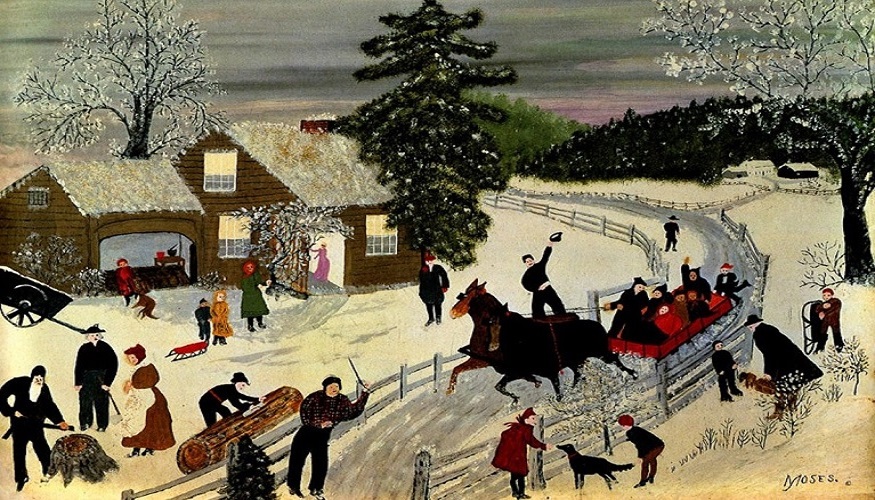
Moses as an acute observer of the nuances of season, weather, and time of day.. Her self-taught style was not conducive to replicating specific local landmarks or events, but there was a compelling virtue to its simplicity. Moving Day on the Farm (1951), for eample, portrays the upheaval and adventure of a family’s relocation while Apple Butter Making (1947) represents both the hard work and play inherent in family chores. The exhibition concludes with her last finished painting, Rainbow (1961), a joyous celebration of life completed when she was more than 100 years old.
Grandma Moses in the 21st Century is divided into five sections. Early Work and Development examines Moses’ initial output and traces her evolution as primarily a landscape painter. The three central parts of the exhibition, Work and Happiness, Place and Nature, and Play and Celebration examine her recurring themes: respect for the American work ethic; sensitivity to local landscape, weather and the seasons; and a love of fun and festivity. Late Work showcases her continuing exploration of these themes and her later artistic techniques.
Moses captured pastoral scenes at a time unmarred by toxic waste and the threat of nuclear anniholation. Bobm shelters spawned later by the Cold War, were not part of her landscape. Apple picking, quilt making, and other everyday tasks that epitomized her home village. Of Eagle Bridge, were. She painted her renowned Joy Ride, for instance, with untutored precision, depicting farm kiddies packed lie smiling ghosts into a red sleigh. In Wash Day, she segues into light-hearted surrealism; petticoats laid out on the lawn and towels and sheets ready to flap into the sky.
Grandma Moses sold her first painting at age 79
Her paintings convey a quiet joy and the beauty of nature. Some regard them as little more than eye candy, a pleasurable experience m ore akin to, say, losing oneself in an amusement park or a box of Girl Scout Cookies than intellectually in the intricacies of a multi textured symphonic masterwork. But other conned that her colorful vignettes about a lost way of life are classsics. Whether a cultural phenomenon or an artist of the ages, Moses gleaned little visibility in the histories of postwar American painting. Exhibition guest curator Jane Kallir attributes the lack of critical enthusiasm to the paradox of her extreme success. "moses was a folk artist until she became famous," Caller said. "Then she became a popular painter, and her art was dismissed because of its mass appeal."
At the same time, the essential warmth of Moses’ work complimented her charming personality and won an ever-growing legion of fans. "She loved Ike and was buddies with Harry Truman," said Bachert. "And she had the press wrapped around her finger." Her depictions of country life struck a nostalgic chord in a nation that found itself increasingly tied to city life. There was rarely even a hint of the city in her work: Simply looking her window in Hoosick Valley, New York provided all the inspiration she needed. In 1955 she appeared on legendary reporter Edward R. Murrow’s See It Now to paint "pretty, old times distillations of time and place." In the same spirit as her other notable creations, including the Quilting Bee, The Lake, Catching the Thanksgiving Turkey, Old Oaken Bucket, Black Horses, Old Checkered House, and Out for the Christmas Trees. "The world that you show in your beautiful paintings is the kind of world we must try to bring back," wrote a fan. There was a link between the present and the past in Moses’ work that seems to secure the future, noted Kallir. Her message that the timelessness of "some things — the scent of summer on the winds fo spring, the bite of the first snow in November — inspired no longing, but hope." A comment in the guest book from one of her exhibitions noted: "I was a mental patient. I am feeling fine now. Looking forward to a new life....When I know you did it, I felt I will also do it. You are my inspiration for life and love."
Moses completed more than 160works of art during a 20-year career. Her name sold greeting cards by the millions, and generated best-selling books. She appeared regularly in radio and television interviews. Unsurprisingly, fame never spoiled her. "If people want to make a fuss over me, I just let ‘em," she said once, "but I was the same person before as I am now." Some believe that her painting ket her going. "It probably contributed to her longevity," Jane Kallir added. "The moment she couldn’t paint anymore, she died."