Billy Bob Meet Albert Einstein
Anatomy of a Museum: From Salt-of-the-Earth to the Atomic Bomb.
How One Man’s Passion for the Past Brought Life to a Lost Legacy.
These very different worlds collided in 1942 when brainiacs from around the country began pouring into a 56,000-acre tract of land in rural Tennessee earmarked for the super secret Manhattan Project. Their work led to development of the atomic bomb and effectively ended World War II. But it also uprooted 3,000 people from their ancestral homes.
John Rice Irwin, just 11 years old at the time, was among those who lived in the area that later became known as Oak Ridge. Irwin recalls the anguished faces of his parents as they returned home one day to find posted notices ordering his family to vacate their five-room antebellum farm home and two tenant houses within 14 days.
The government repeatedly targeted Tennessee for public works projects during those post Depression years, so Tennesseans had become accustomed to being uprooted by Imminent Domain. The Irwins lost their previous home a decade earlier to the Norris Dam, another gargantuan federal project. And while being forced from the creeks, hollows and swimming holes of their youth traumatized them, the Irwin boys and other local kids viewed their relocation at least in part as something of an adventure.
But their parents and grandparents, often poorly educated and content to live out their lives among friends and relatives watching grandchildren grow up, saw the forced resettlement as grave threat. Some literally grieved themselves to death, distraught that their legacy would be buried forever in a mysteriously named federal project, initially known only as the Clinton Engineer Works (C.E.W.), which remained closed to the outside world.
The availability of blue collar jobs that paid the then princely wage of about a penny a minute softened the agony of dislocation for many of the original 1,300 families. Between 1942 and 1945, as scientists and their support staff arrived from all over the U.S., the C.E.W. grew from 0 to 75,000, making it the sixth largest population center in Tennessee.
Under the orders of General Leslie Grove, authorized parties could access "the secret city" through one of seven gates. Silence during the war years was golden. Special undercover agents (about 10 percent of the population) actively looked for information leaks, and Grove situated them in homes with sloping roofs that made spying on their neighbors easier. Job applicants who prattled on too much during interviews didn’t get hired. Those who talked about their work vanished. Employees received constant reminders to keep mum. One warning sign read:
What you see here
What you do here
What you hear here
When you leave here
Let it stay here
But what turned out to be the greatest industrial project in the history of the world finally paid off. Within three years, scientists at Oak Ridge secretly developed enough weapons grade uranium and plutonium to produce a pair of bombs in August 1945 that killed a combined 144,000 people in Hiroshima and Nagasaki, forcing the Japanese surrender.
Two years after World War II, civilian leaders took control of Oak Ridge under the leadership of the U.S. Atomic Energy Commission and, in 1949, the secret city opened to outsiders. Ever since, new generation scientists have focused mainly on harnessing energy for peaceful purposes rather than solely developing a new generation "Little Boy" or "Fat Man."
Today, the site’s old Y-12 facility is still used for materials storage and the processing of nuclear weapons while X-10 is now known as the Oak Ridge National Laboratory, home to two of the world’s most advanced neutron scattering research facilities, the Spellation Neutron Source and the High Flux Isotope Reactor research and development program. Technologies generated there, spanning a wide range of scientific disciplines, continue to give the U.S. super power status.
Despite the overwhelming success of Oak Ridge, the original residents received only a pittance for their land. But it was the priceless loss of legacy that profoundly unsettled many of them, especially John Rice Irwin, whose grandfather had taught him the names of every plant, vine and tree; that ash split easily and made good stove wood; where muscadines, huckleberries, and possum grapes could be found.
The sense of loss drove Irwin, a teacher and writer, to collect memorabilia from friends and relatives, starting with a rusted tin spice grater that his deceased grandmother used to make pies. "A thousand times I had watched her lift the little lid and grab a nutmeg seed and rub it over the perforated grater to shave off enough of the surface for her pie," Irwin said. "It seemed only natural for me to preserve."
From this inauspicious start, Irwin spent his off days hunting other discards, leftovers, and keepsakes, a personal mission that that in a sense brought the mountain people who once owned them back to life. Dressed in a suit, he would often plant himself on the rockers of front porches to chat and perhaps share a meal. Not everyone he encountered on his trips to the country welcomed him, though, and once he even found himself staring into the barrel of a 12-guage shotgun. But his rapport with the locals steadily grew, along with his intriguing collection of mostly homemade items. "My wife wanted to know why I brought in all that junk, and tried to decide where I should be committed."
Irwin’s collection eventually became too big for his garage. By the late 1960s, it had evolved into a 65-plus acre "living mountain village" that featured a log building and two acres of land. Eventually it became the Museum of Appalachia. Today, the museum includes more than 25 buildings, a working farm and gardens, several special programs, and 250,000 items. John Rice’s total recall has enabled him to present every one of the exhibits in a way that gives each its own special identity and meaning.
Tradition informed the work of the rural craftsman exhibited at the museum; their Appalachian creativity shaped it. Their ingenious tools and musical instruments eased their hardscrabble lives and in a sense reflected a genius as true as the innovation of the nuclear scientists who replaced them.
Take the fly-shoot devised by Jessse Gran or the picture frame fashioned by old John Avis, which contains more than 1000 separate wooden pieces. Or Steve Parkey’s wooden pillow, the ready-to-operate whiskey still, and home made mouse traps and home-made barrels. Or the 75 countless skills and crafts mastered by Alex Stewart that eventually won this jack-of-all-trades recognition as a National Heritage Fellow before his death at age 94
Nothing — from the museum’s vast collection of devices and tools, and even a jail cell — was off limits to Irwin. Less practical but equally compelling items include a perpetual motion machine, a carving of a treed coon trapped by baying coonhounds, and a giant devil’s head formed from a grotesquely twisted tree root. And virtually endless homemade musical instruments, from washboards to gourd fiddles. The only criterion: that these items illuminate the past.
Music played a central role in the lives of the mountain people, easing the burden of working in coal mines, cotton mills and on farms while inspiring them to carry on. Irwin recalled his own father’s zeal for an old, perfectly executed fiddle tune that "would make the hair stand up on the back of your neck."
Even the most remote mountain cabin, free of furniture or cooking utensils, invariably contained two or three musical instruments. The Museum of Appalachia’s extensive collection, and its Porch Musician Project, illustrates the importance of these exotic instruments and the sounds that emanated from them that lightened the load of isolation and daunting poverty.
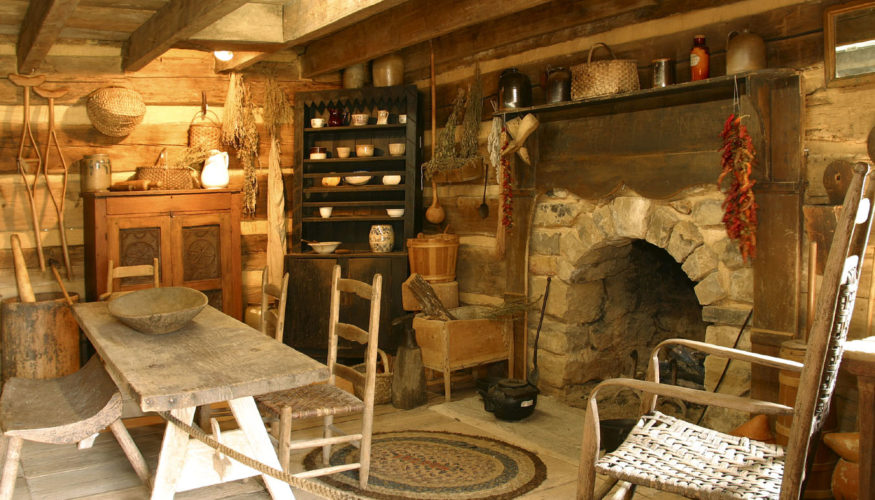
It is its attention to detail that gives the museum special vitality. A rustic cabin featuring a fireplace stacked with wood and all the right touches exudes so much warmth that, on entering, one expects to sit down to dinner with the parents of Mark Twain (the actual former owners); a turn-of-the-century one-room classroom, simple and unassuming, an old tune playing in the background, as if to underscore the resilience of a rare slice of Americana never compromised by homogeneity, where anyone, even nuclear scientists, could learn.
Among the many poignant exhibits, and arguably the most simple, is the old Peters’ Homestead. Pausing on the front porch, visitors can savor a way of life that time has passed by, but also the reassuring fragrance of the peach and apple blooms. Those who listen carefully, as Walt Whitman said, can hear the grass grow, and the strains of fiddle music enticing them to come home.