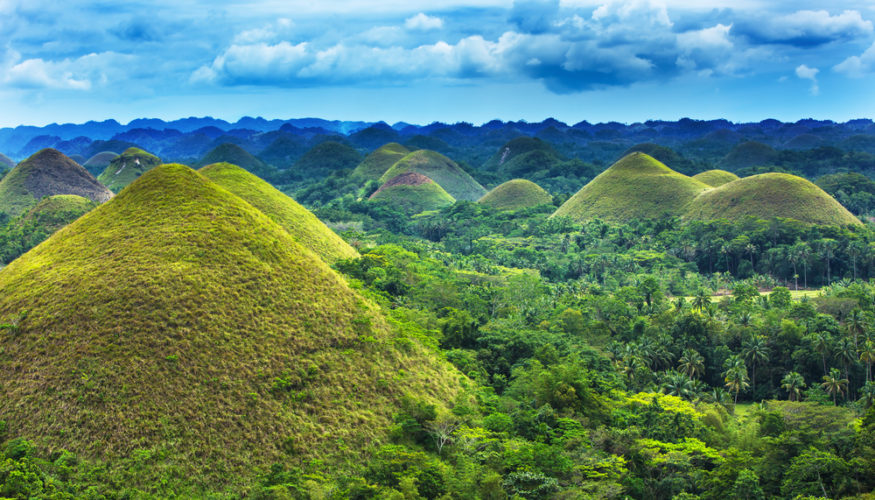
Chocolate In The Chocolate Hills
(The Washngton Times) — I love visiting exotic places, and am an admitted chocoholic, so during long trips have found myself craving the sweet. Sure, the warm, remote countries that I like to go to often aren’t ideal for the candy’s shelf life, but a chocolate bar or two now and then — even one that’s slightly melted — always helps pacify my inner child. Particularly in a place whose very name practically screams out for indulgence: the Chocolate Hills on the Philippine Island of Bohol. Formed ages ago by tidal movements, these undulating haycock mounds are covered by a carpet of dry grass baked brown in the summertime sun that makes them look like huge, bloated Hershey’s Kisses. Many locals consider the hills, which range in height from about 45 to 130 yards, to be the eighth wonder of the world. Legends abound about their origin. According to one, they are monuments to the lasting grief formed by the transmuted tears of a giant distraught over the death of his true love
Though not reduced to tears on realizing that Toblerones or Godivas were nowhere to be found, I did experience withdrawal pangs. Even the tiny gift shops at the Chocolate Hills Welcome Station failed to carry a single cacao bean product. The bitter hot chocolate drink that a waiter eventually brought me from an adjacent cafe — only after considerable prompting — was the best he could do. Chocolate Hills or not, he explained, only the elderly order such a drink, and then only rarely.
Frankly, I would have expected Hershey to have been all over this one long ago, especially since many of hills really do indeed vaguely resemble horizontally challenged Kisses. I pictured a themed gift shop full of chocolate treats replicating the floating restaurants that ply the nearby Loboc River. And certainly edible replicas of the Chocolate Hills themselves. But I spotted not so much as a single chocolate tarsier, the bug-eyed primate (tarsius spectrum) whose miniature, monkey-like countenance hasn’t changed in about 45-million years. One of the creature’s few remaining habitats, Bohol Island (about an hour-and-a-half flight from Manila) seemed virtually chocolate-free. The only hint of commercialism there, period, was evident in the resourcefulness of a pair of sightless masseuses who offered 30-minute, $1.25 massages to visitors completing the 220-step decent from the observation platform overlooking these unique geological formations.
Don’t get me wrong: I prefer natural settings. But having been weaned on a diet rich with television commercials conditions one to believe that even smack in the middle of nowhere someone playing on my sentiments of the moment is bound to try and sell me something. I am never surprised by all the vendors crowding the Washington mall sporting miniature White Houses, et al; at having to run a gauntlet of promotional signs whenever I visit a popular American vacation spot, and by fellow gringos who actually boast about their favorite TV commercials. In the U.S., that is something you just come to expect.
So I wasn’t quite ready for the subdued promotional tempo at the Chocolate Hills and other attractions on Bohol. Chocolate or not, it felt liberating to find none of the usual Madison Avenue hype: no signs, no high rises breaking the pristine skyline and Donald Trump nowhere within rumor. Only two of the 1268 hills reportedly are developed, and only then with a restaurant and hostel. Visitors can enjoy noncompromised views of this eons-old "National Geological Monument." Carmen, Batuan and Sagayan, the picturesque towns nestled in the massive folds of what once was a coral reef and shell fragments, hardly depend on sales of tacky souvenirs (chocolate or otherwise) for survival. Tarsier key chains, barely smaller than the rare, bug-eyed animal (which tips the scales at just 5.3 ounces, measures four to five inches and boasts a tail longer than its body) itself, are about the only hint of commercialism on the island.
The actual animals are found primarily in the coastal forests, rivers and creeks of southeastern Asia, moving from branch to branch with powerful thrusts of their hind legs. They rely on soft, disc-like pads on their fingers and toes to grip branches and the insects, lizards, small fish and crabs that they dine on, making sure during meals to avoid injury to their signature bulbous by closing them.
The Philippine Tarsier Foundation, Inc. (PTF), based in Tagbilaran City, Bohol’s capital, serves as a tarsier watchdog. Endorsed by the country’s two leading agencies for environmental conservation and ecotourism, the PTF monitors the biology and behavior patterns of the world’s tiniest primates in a protected habitat about an hour’s drive from the Chocolate Hills. Visitors can comb through the brush in search of the animals, who have always remained nameless — that is until one of our guides consented to dubbing a haggard — looking eight-year-old male (they live from 15 to 20 years) "Mike" in my honor. Tourists are free to ogle and even pose with the creatures, but that is where the buck stops. There are no tarsier t-shirts or chocolate tarsiers.
Environmental awareness has also led to preservation of the centuries-old churches and other historical landmarks on Bohol. But the main conservation effort has focused off the waters off the 186-hectare nearby island of Pamilacan. After commercial hunting drastically depleted stocks of whale sharks, dolphins and manta rays, the Philippine government in 1997 banned hunting altogether along this migratory pathway and replaced it with ecotourism.
Before the ban, hunters earned from $1,400 to $3,000 for each of the five to eight whale sharks they averaged annually. During the off season, they slaughtered dolphins instead, sharing the catches with slicers, driers, and transporters. Because virtually all residents of the tiny island lived off the hunt, switching to ecotourism temporarily wreaked havoc with the local economy. Fishermen who defiantly continued hunting sometimes ended up in jail.
Leo Sumalpong, 49, shared the anger of his fellow fishermen at first when tensions over the disruption of the local lifestyle threatened to erupt in violence. But ongoing efforts to show that ecotourism ultimately served the community’s best interests gradually converted skeptics like him. Over time, even hardcore opponents of the ban became guardians of their former quarry. With assistance from the World Wildlife Fund and various aid organizations, Sumalpong convinced fellow hunters to switch gears. He helped launch the Pamalacan Island Dolphin and Whale Watching Organization (PIDWWO) to train villagers in marine mammal identification, basic restaurant operations, financial management, and sustainable tourism. Others set up dolphin-watching tours of their own. Now, virtually all these former hunters earn livings from ecotourism.
After heading out to sea at the crack of dawn, I watched awestruck as hundreds of dolphins hungry for a meal of tuna, squid, or jellyfish eventually swam into view in what Sumalpong described as pods of about 20. Females followed with their young, careful to keep a safe distance to avoid injury by the boat. Sumalpong and other former hunters have developed respect for the communications skills and close family relationships of the animals (they can recognize the dolphin leader, a large male they call "Potol," by a cut fin) and strongly support police who ply the local waters in search of poachers.
"If we don’t vigorously enforce the law, then there will be no more dolphins, no more tourists, and no more livelihood," said Sumalpong, who blames poaching mainly on outside commercial interests. He described the effort to preserve the creatures as "our last chance to stay alive." His work has captured the attention of the World Tourism Council, which has named him one of three finalists for its prestigious Tourism for Tomorrow Conservation Award honoring the best examples of tourism development throughout the world.
Watching the spirited dolphins knife through the water, frolicking beside the boat above the area’s stunning coral formations, served as a poignant reminder of how ecotourism can work, not only here, but everywhere. This, and the genuinely soulful affection Sumulpong displayed toward the dolphins, made me completely forget about my craving for chocolate.
But that was fine. The natural flavor there and throughout the island was more than sufficient to pacify my inner child.