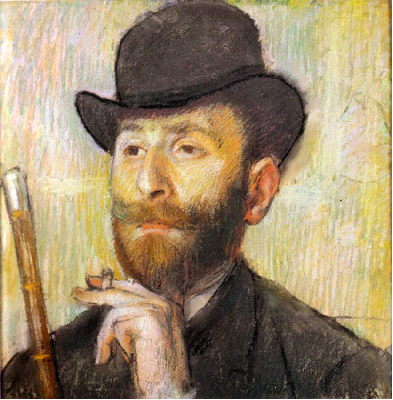
Edgar Degas — A Self Portrait
(Washington Post) No one expected anything extraordinary from the youthful Edgar Degas. An intense, aimless youth, Degas grew up drawing portraits of his family. He intended to become a lawyer, but at age 21 changed his mind after an inspirational visit to painter Jean-Auguste Dominique Ingress in 1855. After enrolling briefly at Ecole des Beaux-Arts, he left to copy the works of old masters at the Louvre and museums in Italy.
By 1861, Degas turned to historical painting, focusing increasingly on ballet dancers and equines. He frequently attended the races in Longchamp and Normandy, not to gamble, but to study the magnificent power of the horses. Soon afterward, the jockeys, their mounts and spectators at the Longchamp racecourse began to appear in his paintings. Carriage at the Races (first exhibited in 1874), Racehorses at Longchamp and scenes from The Steeplechase: The Fallen Jockey (first exhibited in the Paris salon of 1866), are among the 40 paintings and pastels, 60 drawings, and 20 works of sculpture of Degas’s equine art loaned by museums and private collections throughout the world for the exhibit running through July 12 at the National Gallery of Art.
Degas worked in many media, including pastels, counter proofs, etchings, lithographs, and sculpture, plus some 3,500 hundred drawings and 1,500 paintings. The artist achieved widespread acclaim during his lifetime. He so concerned himself with perfection that he hoarded much of his work, preferring to languish in poverty rather than sell any piece that did not meet his high standards. At the time of his death, he possessed so much art that executors of his estate held four separate sales. "He didn’t like to part with his work," said Kimberly Jones, curator at the National Gallery of Art. "He was always rethinking and reconstituting it. He even tried to buy it back."
Besides Carnage at the Races and The Fallen Jockey, other masterpieces by Degas include the Bellelli Family (circa 1850 to early 1860s), Mademoisella Fiocre (one of his largest canvases, on loan from Brooklyn Museum), depicting his fascination with theater, and the New Orleans Cotton Office. He reworked The Fallen Jockey at least twice, Jones said. He remained unhappy with the results, so it never sold."
Degas’ style, subject matter and artistic sensibility distinguished him from other impressionists such as Monet, Renoir and Pissarro whose use of natural light, shadow and atmosphere was juxtaposed with color brushstrokes. Instead, Degas employed complex formal structures and usual perspectives to create ballet dancers, laundresses and milliners. His stubbornness and obsession with perfection alienated some of his staunchest supporters. Jean-Baptiste Faure, a premier opera singer of his day and collector of impressionist art, agreed to return, at Degas’ request, Horses in a Meadow (part of National Gallery’s permanent collection) and other paintings so Degas could perfect them. In exchange, Degas promised to give Faure a group of new paintings. Many years passed, and only after Faure threatened legal action did the artist live up to the agreement.
Severe eye problems ran in Degas’ family. In later years, as his eyesight began to fail, he spent more time working with pastels. Degas never married. As he grew older, he became more demanding of himself, more withdrawn, and more intolerant. The artist had a falling out with collector and close friend, Ludovic Halevy, after the Dreyfus affair inflamed French passions with anti-Semitism. Even after Emile Zola’s J’Accuse exonerated Dreyfus in 1896, Degas remained insistent about Dreyfus’s guilt. Halevy and Degas never spoke again. In his final years, the artist wandered the streets of Paris, a lonely, cranky old man, who occasionally blurted out during conversations with friends that "death is all I think of." He died in 1917.