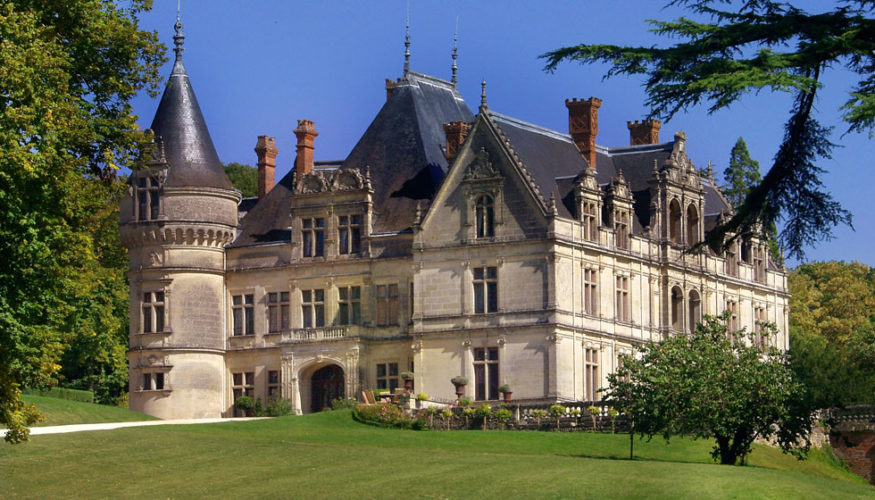
France — Where Home is a Castle
(The Philadelphia Inquirer) — After edging up the steep dirt driveway to the dimly lit medieval fortress at the top of the hill, one half expects to be greeted by Lurch from the Addams Family. Instead, the man who swings open the creaky castle door is bespectacled, 39-year-old Prince Philippe Maurice de Broglie. Prince Philippe is dressed in a tattered pull over shirt and rubber soled work shoes. But never mind. After all, he has baggage to unload and dozens of other chores to attend to around the 120-acre 14th century castle, chateau la Bourdaisiere in the Loire Valley, about a two-and-a-half hour drive south of Paris. Prince Philippe owns Bourdaisiere jointly with his brother, Prince Louis Albert, who is off to England for a week to promote his signature line of prince jardiniere (Gardner Prince) gardening wear. So it’s up to Philippe to see to it that things run smoothly and that guests are happy. That means serving breakfast on time and making sure that the various castle sidelights — swimming pool, tennis court, and riding stable — are operational. Philippe also overseas construction of a new terrace that extends from the dry moat. He also keeps a wary eye on the 300 strains of tomatoes in the castle greenhouse and garden. On top of that, he’s laying out plans for a perfume museum in an underground cavern. The staff of ten carries most of the workload but Prince Philippe serves as an all round utility player, performing sundry chores and fielding a never-ending stream of faxes that pour in from travel agents. "They are always urgent," he observes with his typical dry wit.
A stay in a chateau is an education in French culture, history, and, especially color. (Bourdaisiere, for example, once run by Marie Gaudin, mistress of Francois I, Pope Clement VII and Charles V) today operates unlike any hotel, offering swimming, tennis, and horseback riding. But the rich, aristocratic history of the castles is clearly the main draw, especially for Americans, the majority of visitors, whose democratic roots seem to have nurtured a need to taste royalty firsthand. This is perfect for chateau owners, who increasingly must rely on tourist dollars to foot ever mounting maintenance and renovation bills on their Monuments Historiques. It also sets the stage for the occasional awkward moment involving tourists full of themselves over what their dollars can buy. Here is Prince Philippe Maurice describing his encounter with a clueless Yankee driver of a broken down Mercedes.
"He pointed, ‘You. Come here. My car is not working.’ I turned the key and it started right up. He pointed again, ‘Smart ass, get the luggage.’ He and his family brought four big suitcases. I dragged them into the elevator. He asked me, ‘What do you do here.’ „Well sir,’ I said, I own the place.“ He slapped me on the shoulder, ‘Wishful thinking!’ I took them to their rooms, where the daughters tipped me ten francs, which I kept, of course. I asked Mme. Magnien to tell them, The prince will be waiting for you in the drawing room at 7 p.m. I dressed in my black tie and velvet jacket. When he got there, he said, ‘Have I seen you somewhere before?’ I told him, ‘I don’t think so.’"
Philippe, an ex stockbroker, and Louis Albert, a former merchant banker, trace their roots to Italian fighters whose prowess on the battlefield wowed early French rulers, who rewarded them with favors all the way up the royal chain of command. De Broglies eventually became dukes and princes, Philippe said, and their offspring generated prime ministers, religious figures, writers,noms des 6 academicians, and Louis de Broglie, winner of the 1992 Nobel Prize. Philippe and Louis Albert, both bachelors, have opted to make their mark as innkeepers. They entered the chateau business five years ago by combining family funds and winnings in the stock market to buy the 14th century citadel, then a dilapidated, condemned nursing home. They renovated and restocked the hulking fortress with hundreds of family heirlooms and began soliciting paying guests to stay in what now amounts to 17 bedrooms. Some of Bourdaisiere’s history is unclear. But this much is known: Francois 1 built the castle for his royal mistress, Ms. Gaudin. Later on, Henry IV dropped by for romantic encounters with Gabrielle d’Estrees, Gaudin’s granddaughter. Whether the 20-foot royal red poster bed, the midevel-ish wooden ceiling beams and centuries old paintings that adorn the contemporary Henry IV room actually bore witness to royal philandering — and whether Henry actually slept in the room named after him — can only be left to the imagination.
The best way to get to Bourdasiere or any French chateau is to drive. While renting a car in France costs about four times as much as in the U.S., it beats the high prices for train or airplane tickets. A goodly number of French castles are owned and operated by counts, dukes, and disproportionate others of royal blood. The castles for the most part are exquisitely appointed, absolutely wreaking with history and often open for stays to the vacationing public. Some, such as the ruins at Chinon, are so important historically that they function only as unrestored government museums. Others, such as Chateau d’Artigny, a 53-room white stone palace in Montbazon south of Tours built by the famous perfumer, Francois Coty in the style of the XVIII century, feature state-of-the-art conveniences, swimming, tennis, and golf. Dining can run the gamut. Bourdaisiere serves only breakfast. But Restaurant Belle Roche just a short walk away serves superb five course meals for about $20. Meals at Chateau d"Artigny cost three or four times as much, but are first rate by any standard (The wine list alone includes hundreds of selections dating to vintage 1900). Food at other chateaux ranges from good to downright mediocre. Newer chateaux such as d’Artigny may lack the historical charm of those that have been in the same families for generations but can make up for it in comfort. Old chateaux can suffer from too much renovation. Rooms at the imposing 16th century Chateau Brissac, one of the most famous French castles, are well appointed with museum quality pieces, but seem somewhat diminished by the efforts of suave owner Marquis de Brissac to completely modernize the upstairs quarters where he lives with his two children and his wife, an ex dancer.
Chateau de Canisy, about a three-hour drive from Paris and nearby the Normandy beaches, is anything but modern. Enlarged and remodeled in the 16the Century, it includes 20 bedrooms filled with impressive antiques and patterned fabrics on the walls. Many of the rooms overlook a vast, private lake that in the early morning is blanketed by a thick mist and a numbing calm barely broken by murmuring birds. Canisy is advertised only discreetly and includes modern conveniences no more intrusive than hair dryers available for visiting female guests who request them. The chateau, built after William the Conqueror’s invasion of England, has been home since the 111th century to the family of Count Denis de Kergorlay. It survived both French revolutionaries in the 18th century who guillotined Kergorlay’s relatives and members of the Nazi high command who took over the castle during World War II, performed military drills in the huge courtyard, and eventually arrested the count’s grandparents. Gen. Omar Bradley temporarily took up residence there after American troops invaded the Normandy Coast.
De Kergorlay had no desire to run Canisy himself. But after his father’s death, he quit the French diplomatic corps to prevent the chateau from falling into the hands of a younger brother who entertained ideas about transforming it into a monastery. De Kergorlay, or Denis, as former visitors fondly refer to him, soon began inviting "Friends of Canisy" — artists, writers, and politicians with often-divergent viewpoints — for weekend stays. Over the next decade, the soirees at the 20-room, 600-acre estate became one of the hottest tickets in France. After marrying at age 42 in 1989, de Kergorlay’s wife, Marie Christine, encouraged him to turn the chateau into more of a profit center and less of a money pit. Namely, by inviting paying guests. The chateau bears no resemblance whatsoever to a hotel. The count, a quiet, powerfully charismatic man who speaks flawless English, personally shows newly arriving guests to their rooms. He greets them at an appointed time in the parlor room for pre-dinner drinks and hors d’oevres, then afterward ushers them into an elegantly appointed dining room for a full course formal meal and stimulating conversation beneath a variety of impressive still lifes — some painted by his grandmother — and an imposing mural that depicts wild dogs tearing apart a leopard.
Conversation can vary, but the participation of de Kergorlay’s ancestor Sir de Carbonnel in the Battle of Hastings, the beheading of three relatives July 14, 1794 in the weak of the French Revolution, the brutal machinations of the Nazis, and the temporary occupation in post war France by a group of asylum escapees inevitable come up. On the lighter side, discussions revolve around political trends in modern France, the count’s friendship with Joan Baez, and the decision by young women in California and Australia to fly an entire entourage to Canisy just to get married. Some guests even claim to have witnessed the presence of a friendly spirit, said to be the count’s grandmother, whose bedroom doors mysteriously slam shut. One guest tried to scare his friends by dressing up as a ghost. Canisy and other French castles aren’t for everyone. After a well-heeled American traveler got an eye full of the castle’s notable lack of modern conveniences, he indignantly complained to Denis, "I can’t stay in a place like this." The count politely directed him to the nearest hotel.