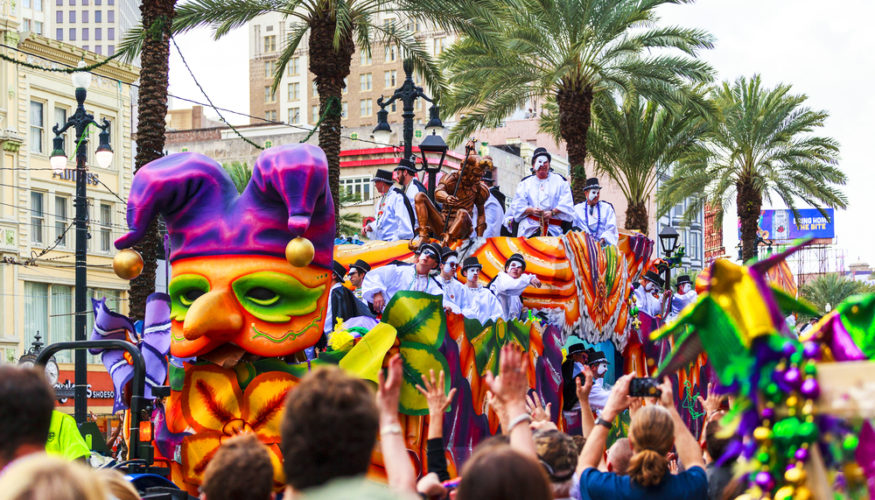
Grabbing For Beads
The bayous and marshes of Southern Louisiana aren’t much more than an hour’s drive from New Orleans. But these endangered wetlands and the Cajun fisherman and rig workers who depend on them for their livelihoods and cultural sustenance are a metaphorical world away from the sassy blare of French Quarter trumpets.
The determination of these French descendents to let "the good times roll" — les bon temps roulez — at Mardi Gras and other festivals despite the steady erosion of their land mirrors a kind of "it’s-bad-but-you-might-as-well- make-the-best-of-it" defiance vaguely reminiscent of the musicians who played as the Titanic went down.
But their resolve to pass a good time and fais do-do (dance, sing and gorge) also reflects the inextricable link between Cajun culture and the land it depends on for nourishment and survival.
The sensitive marshland of the bayous, long at the mercy of Mother Nature, literally began to unravel after the construction during the 1920s of canals to transport oil from the Gulf of Mexico. Salt water has filtered into the area ever since, killing Cyprus and other vital vegetation, and enabling the mighty Mississippi to more easily sweep silt vital for replenishment of protective barrier islands out to sea.
Despite the persistent threat, most consider relocating to be unthinkable. "It would make sense to relocate," said Kelly Gustafson, a lifelong resident of Houma. "But I could never bring myself to sell my land. It belongs to the family, and therefore it’s sacred."
The U.S. Geological Survey describes the Southern Louisiana coastline as one of fastest disappearing landmasses on earth. Every year for the past 50 years the gulf coast has surrendered an average of 34 square miles of wetlands. The state is on track over the next half century to lose an additional 700 square miles of land — the size of the greater DC/ Baltimore area.
The biggest wake up call came in 2005 when Hurricane Rita scored a direct hit on Houma (pop. 33,000), gouging out a 13-square mile chunk of Terrebone Parish and accelerating land loss there by four years. Besides Rita, three have been three other major hurricanes in recent years (Katrina in 2005; Ike and Gustav in 2008). Many fear that the next monster cane could deliver a knockout blow to any of the threatened areas. That is why the Bayou Terrebonne Waterlife Museum says of the region: "the worst natural disaster in American history is happening right here right now."
Six of the eight southern Louisiana parishes encompassed by Cajun country lie directly in the line of fire of hurricanes that swoop in from the Gulf of Mexico, sometimes cutting massive swaths of destruction and speeding erosion of the wetlands. But black-booted Cajun shrimpers, trappers, crabbers and oil workers defiantly scoff at the idea that mother nature can stop them from laissez les bon temps roulez. Call it denial. Call it bravado. But mostly call it raw determination to hang on in the face of daunting odds."People say, ‘you should just get out,’ said Gustafson." "But this is home. This is our life. Where else would we go?"
Because fleeing to higher ground is unthinkable to many locals, they dig in their heels and redouble their embrace of all things Cajun. That means hearty cuisine, robust music, street parties and nightlife so intensely unique that it makes Cajun country seem more like a state of mind rather than a place.
The monuments here are not churches or museums but living landmarks to quaintness. At the Cecil Lapeyrouse Grocery Store, built in 1914, one can buy food, pipe fittings, antiques, collectibles and — count ’em — no less than six varieties of dried pork skins. Boat operators can fill up at the store’s rear dock, which straddles a canal patrolled by alligators and airboats.
The famished can fill up on signature catfish and peanut butter cheesecake at A-Bears down home eatery, or dig into 7-pound piles of boiled crawfish that waiters unceremoniously dump on newsprint covering the tables at Boudreau and Thibideau’s Cajun Cookin’. Diners can also chow down on other specialty dishes, including dirty rice, hearty gumbo or crock-pot jambalaya.
Quintessential Boudreaux and Thibodeaux jokes appear both inside and outside the restaurant, offering tongue-n-cheek insights into the Cajun mind. Native Houman Rick Parsons can’t resist telling one of his own. To wit: Boudreaux: If I was to make love to your wife, and we had a child, would that make us related? Thibodeaux:"No, it would make us even."
This party-hearty posturing regardless of what tomorrow might bring prompts even couch potatoes to get up off their duffs and, as a Cajun might say, "splash on a little fru-fru (slang for perfume), ball (boil) some crawfish and head for a kick ass good time on the levee." Blowhard or not, at no time is this more apparent than during the annual Mardi Gras.
Plenty of Cajun communities claim their own Mardi Gras celebrations are second only to those of New Orleans.
But if quantity and passion are any measure, then Houma, with 14 parades, countless marching bands and society balls, and a seemingly endless supply of eagerly sought after throwaway beads and trinkets, can rightfully claim bragging rights to the number two ranking .
Settled originally by Houma Indians and incorporated in 1834, "the heart of America’s wetlands," as locals refer to it, is 57 miles west of New Orleans. The town draws nowhere near the number of Mardi Gras partiers who flock annually to the Big Easy. But the sheer volume of beads, doubloons and stuffed animals tossed from its floats — at least per capita — no doubt dwarfs the trinket output of other Carnival parades.
The fact that Houma and the surrounding areas are persistently threatened by hurricanes prompts a live-for- the-moment, tomorrow-be-damned worldview that during Mardi Gras can easily lurch toward excess. That means occasional outbreaks of fighting, and even the odd shooting (though not on the scale of New Orleans, which reported 13 gunfire assaults during Mardi gras 2009). It does not mean flashers, transvestites, and the woman who perches on her Bourbon Street front porch wearing only body paint.
Trying that in Cajun country will land you in jail. Then again, maybe not. After all, one of Houma’s parade queens, Jenny Ledet, set the tone during the 2009 events by sipping wine and searching for balance in the back seat of her chauffer driven red convertible as she tipsily offered toasts to the crowd then, as beads rained down all around her, repeatedly bellowed: "This is f****** awesome!"
But the main interest of most onlookers is in accumulating as many beads as possible. These multi-colored imports from China are tossed and sometimes hurled from passing floats toward anyone who catches the attention of the throwers. Not just individual necklaces but often entire bags of them. Spectators who don’t react quickly enough can end up with black eyes.
If New Orleans is the Big Kahuna of Mardi Gras in the U.S., then Houma is the Big Enchilada of Mardi Gras beads. In the Big Easy, parade watchers are lucky to catch a single strand of beads, according to Houma Parade Captain Jimmy Clinton. Clinton said that the bead loads on some Houma parade floats weigh more than the floats themselves, and that an aggressive grandstander can wind up with a bead stash so big it’s hard to haul away. And that does not even take in account the stuffed animals, plastic doubloons, cups and other trinkets.
Grabbing for beads in Houma and other threatened areas along the Louisiana coastline underscores the fierce determination of Cajuns to cling to their heritage and the land that sustains it, even if that means defying the forces of mother nature. Everywhere along the six-mile parade route, onlookers hold up babies, stand on benches, and wave their arms frantically, imploring those on the passing floats to unleash trinket treasures their way. Some position baby strollers at the guardrail. Others hold their children aloft to krewe members riding aboard the passing floats. When policemen aren’t around, the most brazen of the beggars step around guardrails in hopes of coaxing a stuffed animal for a supposedly deserving but sometimes fictional child.
Getting smacked in the face by beads smarts. But in Houma and other bayou towns where Mardi Gras is more an obsession than an event, this seems to be of little concern. Whether those positioned on the passing floats are matronly grandmothers or wannabe or never-were quarterbacks eager to lighten their stashes of beads doesn’t seem to matter, either. The rowdiest of krewes won’t hesitate to dump entire bead bags all at once, particularly on the heads of newcomers bearing signs proclaiming their first time status. Sometimes aggrieved parties in the crowd hurl the beads right back. But most just scramble after them. Grown men and women exploring their inner children sometimes caught looking the wrong way can and do go home with shiners.
That can also happen if a particularly prized trinket becomes a bone of contention. A scuffle nearly broke out near me when a teenage boy with a tattoo and a self-righteous smirk leapt to intercept a 12-foot serpent that a Krewe member intended for a little girl. But with cops out in force and two cruisers for every float, passions quickly cooled and the antagonists avoided cooling their heels in the slammer.
Mardi Gras celebrations trace back to France of 2500 years ago, when Druids greeted the arrival of spring by sacrificing young bulls to entice the gods to bless their villages with productive livestock and fertile women. Farmers tossed handfuls of flour to encourage better harvests.
After Christianity spread throughout Europe, church leaders lured converts back to the fold by sanctioning the celebration of this pagan ritual on condition that it be followed by Lent, the 40-day period of abstinence and penance. Lent came to be known as Carnival (from carnivalvamen, Latin for "back from the flesh), while the final day of the pre-Lenten Carnival celebration gained acclaim under its new French name. In Houma, the only thing religious about Mardi Gras these days seems to be the fervor of its celebrants.
The frenetic harvesting of parade trinkets might be interpreted as a way to resist the injustices of the past by clinging to what remains. This insecurity perhaps stems from the seventeenth-century British expulsion of the Acadians from Canada for being Catholic (Le Grand Derangement) and the slow dismantling of contemporary Cajun (derived from Acadian) culture because of assimilation and land erosion. Although French was once commonly spoken in Cajun country, use of the language waned after the Louisiana Purchase and has been in decline ever since. And latching onto beads, a stuffed monkey or bear thrown from a parade float perhaps symbolically recaptures that.
The dilution of Cajun culture is symbolized in part by the proliferation of chain stores that have given cities and towns all over the U.S. the same face. Houma, where Walmart, Best Buy, Dillards and the other usual agents of homogenization knife their way along Highway 90 and West Park Avenue, stopping short of downtown, is no exception.
The big box stores made goods in Houma and other threatened Cajun communities more affordable, but at the cost of assimilation. If alive today, de Tocquville might view the cookie cutter malls there as more menacing to our unique national fabric than slavery, which in the 1820s he predicted would ultimately destroy the nation. Plans are underway in Houma to halt further franchise encroachment by shoring up the architectural integrity of the downtown area. But efforts to preserve the wetlands are far more elusive and costlier.
Despite their dour future outlook, most in Cajun country are staying put. To move just wouldn’t be in keeping with the Cajun character, according to Houma native Rick Parsons.
Why would anyone return to an area that ultimately is destined to disappear? he asked rhetorically. "Because it’s home," he responded to his own question. "It’s where we live. We’re not about to let something catastrophic stop a good party."
Laissez les bon temps roulez.