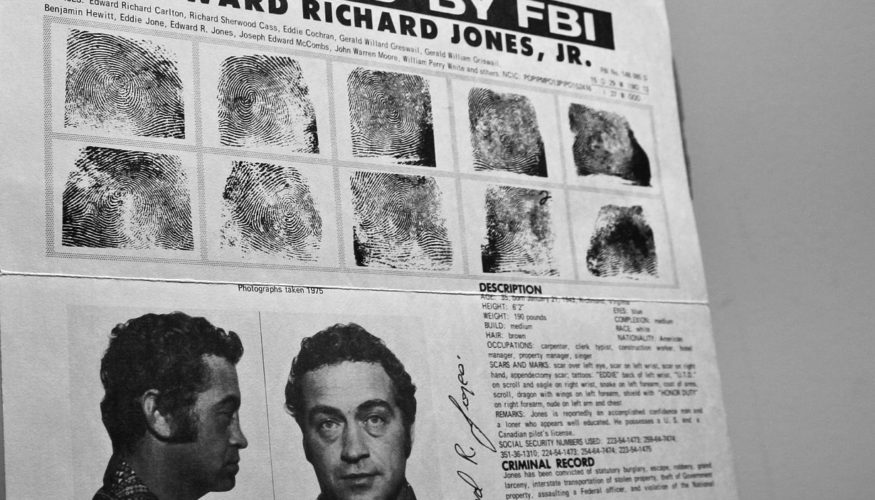
Hacksaw Jones, Master of Escape
(Philadelphia Inquirer) — It was at Honolulu’s Ilikai Hotel, during a penthouse party attended by his Polynesian pop-style band — the Modernesians — that Hacksaw Jones snatched the $3,000 in traveler’s checks he found lying on the floor. "We had a gig coming up thousands of miles away in Seattle," he recalls. "I figured I could get away with it." Instead, the singer, drummer, drifter, jack-of-all-trades and con artist extraordinaire got caught. Several days later he found himself in the holding tank at the Seattle jail, in the company of Robert White — a young man of roughly the same appearance who had been hauled in for being drunk and disorderly. Jones immediately began picking White’s brain, and when the jailer called for White’s release, it was the Saw who presented himself.
He gave the booking clerk White’s age, address and social security number, then casually walked out. The jailer later found White tied up with a bed sheet.
This was only one in a long line of ingenious schemes devised by 41-year-old Edward Richard Jones Jr., America’s premier prison-escape artist. For the moment, the man the FBI nicknamed "Hacksaw" is back in the slammer, marking time.
But Jones vows that his escape days are over; that his past actions have brought much pain to his mother, Mrs. Heddie Bosher, who is dying of cancer; and that he seriously wants to go straight, for her benefit and his own.
"My mother is the most important thing in the world to me," he says in a soft Virginia drawl. "I promised her that I would never escape again, and I have no intention of going back on my word."
Tell that to law enforcement officials, and they will laugh.
"Who’s he kiddin’?" says former U.S. marshal Don Forsht. "He’s one cool cat. He could damn near get out of anything. You’d put him in solitary confinement; he’d laugh and say fine, he needed to catch up on his sleep. Then, before you knew, he’d be gone. He’ll try again. It’s in his blood. Just give him time."
"I’m serious," Jones insists.
"Look at his record," Forsht says. "Then you tell me."
Like a modern-day Houdini, Jones has used ball-point pen cartridges, toothpaste tubes, a wax dummy, hacksaws, a splinter from a plastic cup and even a tape cassette with 30 minutes of prerecorded snoring to aid in his spectacular escapes. From San Diego to Seattle and Maine to Miami, his exploits have both amazed and embarrassed prison officials.
"I never was nervous during the actual escape," Jones says. "But every time after I got free, I’d get these horrible shakes and nightmares and practically throw up thinking about what could have gone wrong.
"I hate zoos, and escaping just seemed like the natural thing to do. And I can tell you this: Escaping from jail is better than sex, better than any high, better than anything you could possibly imagine. Personally, I never considered escape a crime. If you catch a wolf in a trap, he’ll gnaw his own leg off to get away. You put a man in a cage; it’s human instinct for him to want to get out."
Born in Richmond, Virginia, his initial brush with authorities came when he was only eight years old. "I was running around wild, playing hooky," Jones recalls. "My mother was working. They said I needed more supervision.
That’s exactly what he got at the Beaumont School for Boys. Run like "a chain gang," Beaumont developed rather than suppressed any inclination he may have had toward the world of crime. At 15 he got into trouble for forging his stepfather’s name on a $50 check.
His first major legal problems occurred two years later when he bought his first wife, Gloria, a "Hot" diamond ring. He was tried as an adult and sentenced to ten years for grand larceny by possession. Jones found himself on an honest-to-goodness chain gang at Prison Camp 21 in Falmouth County, Virginia.
"It was an awful place, worse than anything you can imagine — run by people who should have been in jail themselves," he recalls. "I actually saw a guard kill a prisoner who tried to escape. He had fallen down during the attempt, but the guard ran up and shot him anyway. I may have been no angel, but I certainly didn’t belong in that hellhole alongside all those hardened criminals."
Jones sustained himself by counting the days until his first parole hearing. But when his application was rejected, he decided to make his own parole.
His job was to operate a pneumatic dirt tamper in trenches in and around the prison. He carefully studied the movements of the guards, and at just the right moment he wired down the trigger of the dirt tamper so that it kept pounding away on its own. The guards were convinced he was still at work. When they discovered he wasn’t, Jones was long gone.
Authorities apprehended him again four months after he hired on as a security guard at the Samuel Triviani Detective Agency in Philadelphia. Soon he found himself aboard a prison van, speeding toward the Virginia State Penitentiary.
But not for long.
During his first prison term Jones had mastered the art of twisting ball-point pen cartridges into makeshift "keys" with his teeth. Using this technique, he picked open his shackles and cuffs and leaped out onto the road while the van was moving at 40 mph.
Jones scraped his hands and feet and lost a shoe. Yet he managed to keep going, getting as far as a local bus terminal where police arrested him just after he purchased a ticket back to Philadelphia. This time they succeeded in sending him back to the Virginia pen.
He stayed there only three weeks before implementing an escape plan that began with collecting hair from the prison barbershop, plus other materials from miscellaneous sources. Using coat hangers for arms, he built a cardboard dummy, sneaked it into a prison latrine, wedged a newspaper in its hands and propped it on a toilet. It was night before the guards began to wonder how he could read in the dark. They later found a four-foot beam he had left leaning against the outer prison wall.
Jones ended up in Miami at the Americana Hotel, where he swept the pool and rubbed suntan oil on the women draped on chaises at poolside. Hacksaw claims that he is not a ladies’ man, but women always seem to find him attractive. Many of his arrests have occurred in or near bedrooms, and the woman have always been surprised to learn whom they’ve been sleeping with.
Growing homesick, he eventually headed to Richmond to visit his mother and soon wound up back behind bars — this time on a burglary charge.
But not for long.
Jones sawed his way through a grill over an air vent in the back of his cell at the Chesterfield County Jail, and then drifted to Denver, where he tended bar at the Clown’s Den. Before joining the Modernesians band in 1967, he also worked for a while as a property manager in Los Angeles.
By then Jones had become a master in the art of escape. But he appeared equally skilled at getting caught. Soon after he eluded the traveler’s checks prosecution, slipping out of jail by posing as another man, a couple of rookie cops surprised him outside the motel room of Linda Arciaga, lead singer of the Modernesians. The cops had found a card with her name and address that Jones had left behind.
"He began running," recalls one of the policemen, T. Michael Nault. "We fired two warning shots over his head, and he hit the ground real hard. He said he was pretty mad at himself, getting caught by a couple of rookies."
The state of Washington was also pretty mad; a Seattle judge sentenced him to a ten-year term at the penitentiary in Walla Walla. After serving 14 months, Jones was shipped back to Virginia to stand trial for his escape from the Chesterfield County Jail.
"They put me in the same, identical cell I’d busted out of four years before," Jones reported. "They said, "You’ll find there’ve been some changes."
The grill was now welded to the vent, but Jones was prepared. A friend in Washington had given him a hacksaw blade, which he had glued in the sole of his shoe. "I went through those welds like nothing," he remembers.
From there Jones went to Las Vegas, where he had beginner’s luck at the Caesars Palace baccarat table, parlaying $200 into $13,000 during a single evening of frenzied play. He bought a new Pontiac Trans Am and, to break it in, drove across the U.S. He got as far as Shreveport, Louisiana. A pretty legal secretary named Susan Black was changing a tire. It was raining very hard. He stopped to help.
He gave her a false name and history. They ended up getting married (by this time his marriage to Gloria had been annulled). Trying to go straight, Jones got a job at a local Dodge dealership.
"It was awful," he says. "A nice middle-aged couple would come in, and I was supposed to stick "em with a turkey. I just couldn’t handle it."
In August 1971, hoping to repeat his winning night at Caesars Palace, he took out $1,000 from his bank account and headed for the Las Vegas Strip. Ten minutes after sitting down in the Frontier Hotel’s casino, he had lost everything. Then he spotted some Japanese tourists at the casino bar who were stuffing $100 bills into a plastic shoulder bag.
"I followed them up on the elevator and found out what room they were in," he says. "Then I went down by the pool and nursed a drink and waited."
Two hours later the light in the fourth-floor bedroom went out. Jones clambered up a series of balconies, tiptoed into the room, grabbed the bag and went down the way he had come. But as his feet hit the ground, a security guard sneaked up from behind him and slammed a five-pound clock over his head, knocking him unconscious.
Jones woke up at the Sunrise Hospital wearing an open-backed surgical gown and a turban of bandages. There was a tube in his nose, an I.V. needle in his arm and a catheter in his penis. He was held down by an assortment of chains and shackles.
When a nurse showed up to give him a sponge bath, he modestly asked he could wash himself. The obliging RN left him a pan of soapy water and drew the curtains around him.
Jones promptly yanked out his I.V. needle, bent it with his teeth and within minutes managed to pick open three of his four locks. Time was running out. He was able to pull the bed apart, wind the remaining chain around his leg and then — taking a deep breath — rip out the catheter and nose tubes before fleeing down the hall.
"I was lucky," he said later. "I was on the ground floor, and the cops who were supposed to be guarding me were down the corridor flirting with some nurses. They all started yelling, "Halt! Halt!’ My gown was flapping. My bare ass was shining like a new moon."
After jumping several fences, he hid behind a porch sofa while police carried out a house-to-house search. It was dark when he peered out from his hiding place — and found himself looking into the wrong end of the homeowner’s gun.
"I decided to gamble," Jones said. "I told the man with the gun, "Look, mister, I’m not going to hurt you. But I’m not going to stay here either.’ I walked away and didn’t look back. I was lucky. He didn’t shoot."
The Saw snatched some laundry off a clothesline and then hitched to Los Angeles. For the next few years he drifted between California and Texas, working primarily as a property manager. The fact that he was wanted in three states at the time caused Hacksaw little concern.
At one point he even hired a sheriff’s deputy to work for him as a part-time security guard. Things went smoothly until the day a former guard from his old Virginia chain gang happened to apply to rent one of the apartment units he managed in Houston.
Jones wasn’t about to test his luck. He took off at once and managed to steer clear of the law until being busted for speeding in Lincoln Parish, Louisiana. When officers fed his name into the crime computer, it went crazy. Jones soon found himself back in jail.
But not for long.
With his teeth, he fashioned a handcuff key from a ball-point pen cartridge and then asked to make a phone call. The guard handcuffed him to a radiator beside the phone just outside his cell, then agreed to fetch Jones’s imaginary phone directory. While he fumbled around under the mattress, Jones quickly freed himself and slammed the cell door shut. He was free again and off to Florida where in short order he stole an estimated $5000,000 in gems from a Fort Lauderdale jewelry store.
Police caught up with him two weeks later at Susan’s home. But when they took him away, they failed to notice two concealed hacksaw blades taped to his forearm. "The backs of your arms remain out of view the whole time they strip search you," he explained. "The only ones who didn’t realize that were the police."
That same day he managed to saw his way out of the Federal Corrections Institute in Tallahassee and disappear into some nearby woods. After a snake bite slowed him down long enough for sheriff’s bloodhounds to catch up, he found himself back in the can.
A few days later, using the second hacksaw blade, he sawed his way out again. Jones was halfway across the prison yard when an alarm sounded and embarrassed guards recaptured him.
This time he was booked into the Broward County Jail under the tightest security. Jones freely admitted to the Fort Lauderdale robbery, but claimed his involvement came at the urging of Joseph Sirgany, a 62-year-old "pillar of the community" who wanted to collect insurance money. "His pleas went unheeded.
Frustrated by what he termed "bureaucracy" and "the double standard," Jones began plotting another escape. Eagle-eyed guards were ready for him this time. They discovered a ballpoint pen cartridge in his toothpaste tube and three hacksaw blades in his yellow notepad. They also caught him trying to simply walk out by posing as his own defense attorney, John Ferdinand, who calls Jones the most remarkable client he has ever had. Of Hacksaw’s uncanny ability to remove himself from incarceration, he has this to say:
"It was just a big game with him. He was happy-go-lucky and nonviolent, the kind of guy you almost have to like. He just basically loves to escape from jail."
There was no way guards at the Broward County facility were gong to let Hacksaw Jones make fools of them all again. As a constant reminder they posted a special set of instructions sent by the office of the United States Marshall:
CAUTION
"This man is extremely dangerous. He will fake illness, blackout spells, etc. He will go to any lengths to escape. He should not be handled by air(plane). Handcuffs and leg irons must be used! It cannot be stated too strongly as to his escape potential."
Things looked bleak for the Saw. So he offered to lead the FBI to the stolen gems if they agreed to take him to Atlanta.
According to former U.S. Marshal Don Forsht: "the FBI said, "There will be three of us and three of your men with him.’ I said, "Shee-yit. He just wants to escape.
The FBI went over Forsht’s head and made the trip anyway. Handcuffed to U.S. Marshal George Spell, Jones led six law enforcement officers in two cars to a vacant, junk-littered lot off Roswell Road on Atlanta’s north side. He lit a cigarette and pointed out where the men should dig. While they were busy, he leaned over to stub out the cigarette, then reached for an orange rag he had hidden in a pile of rubbish following the Fort Lauderdale jewel robbery. The rag was wrapped around a chrome-plated Cold Python revolver with a broken firing pin.
Jones held the gun to Spell’s head and said, "George, you better tell "em something."
"Boys, he’s got me," Spell shouted.
Jones tied up the lawmen, ripped out the ignition wires of one car and asked Spell for his wallet. He took out $50, returned the wallet and roared off in the second vehicle, forcing the furious officers to walk a half-mile to a pancake house where they called for help. A police dragnet combed the area for Hacksaw. They found him drunk and soaking up sunlight beside a Holiday Inn swimming pool.
He was hustled off to Shreveport, Louisiana, and dumped in a cell monitored by round-the-clock closed-circuit cameras. He wasn’t even allowed to brush his teeth without supervision.
The tight security didn’t stop him for long.
Weeks later, while key prison officials were spending the Thanksgiving holiday at home with their families, Jones was making another escape. He had managed to cut up a plastic up in the shape of a knife, then wrap the "blade" with cigarette foil. He had also made a slingshot from a rubber band — using soap ball ammunition to shoot out the fluorescent lighting. When the guard came to check, the Saw pulled the "knife" on him, locked him in the cell, then slipped past an army of police.
His escape touched off the largest manhunt in Louisiana history. Hundreds of outraged police were called way from their turkey dinners. For eight hours they combed a ten-block area in search of Jones. A rookie cop found him hiding under a trailer, just 100 yards from the jail.
When Jones finally stood trial for the Fort Lauderdale robbery, Broward County Circuit Judge Paul Marko sentenced him to 55 years in prison. The judge tagged on eight more years for transportation of gems across state lines. Hacksaw was sent to the federal prison in Atlanta. Only one man had ever broken out of the facility — until Jones came along.
He did it by building a lifelike dummy with wax stolen over the course of five months from the prison dentist’s office. At bedtime that night Jones simply turned on a cassette player with 30 minutes of prerecorded snoring, then carefully sawed through the bars. He taped the bars back into place, painted over the tape, then threw a knotted bed sheet over the prison’s north wall.
Infuriated guards combed the area for miles around before finally give up. They assumed Jones was long gone. He wasn’t. The whole time he had been hiding in a boxcar in the prison freight yard. A day-and-half later the boxcar finally rolled to a warehouse outside the prison. During a lunch break Jones walked away.
The long arm of the law caught up with him again in San Diego, where he had been working as a bookie. Secret Service agents traced some counterfeit money to him. While authorities were trying to figure out what to do with Jones, he received an emotional, 18-page letter from his mother begging him to stay behind bars.
"I called her, and we had a long, moving conversation. When Mom and my daughter, De De, came to see me, we all broke down and cried. I suddenly realized all the pain and suffering I had caused them; that hit me like a ton of bricks. I knew from then on that I would go straight and never try to escape again.
With Jones back in prison, police took a closer look at the Sirgany jewel caper and discovered that Sirgany’s store had been robbed five times in six years. In 1981 Sirgany was convicted of masterminding one of those robberies, worth $5 million, and sentenced to five years’ probation.
"I’m no angel, that’s for sure," Jones admits. "But it wasn’t fair for me to get 63 years, and Sirgany to get five years’ probation."
Jurisdiction in the case was then out of Judge Marko’s hands. But in a letter to Jones the judge took note of the disparity and promised to ask the Broward County District Attorney’s Office to look into the matter.
Judge Marko also had this to say:
"He (Jones) is a great jewel thief and escape artist, but he is also a remarkable individual. With the kind of mind he has, he could have been a great teacher, or lawyer or judge."
Despite his long rap sheet, Jones has never been accused of anything more serious than the nonviolent theft of jewelry and cash. He has never harmed anyone in the commission of his crimes. He eventually hopes to win parole and eventually pursue legitimate work as a writer or security consultant. In the meantime he’s playing ball with prison officials by sharing with them his special insight into jail security systems, as well as insisting that his current prison address be kept secret.
Jones’s present preoccupation is the deteriorating health of his virtually penniless mother, who suffers from emphysema and asthmatic bronchitis. Her physician estimates she has only a 10% chance of living more than two years. "All she wants is to see me walk out of jail for once instead of escaping," Jones said. "All I want is to tell her as a free man that I love her."
To keep his mother alive long enough to see him free again, Jones is trying to sell one of his kidneys. "I’m desperate," he says. "All I’m asking for my kidney is that the recipient guarantee that $1,000 a month will be paid for my mother’s future medical expenses when needed for a period of up to a year. It’s a hell of a thing, rotting in jail and watching this happen to her. I feel that donating my kidney is the least I can do."
In the meantime he marks off the long hours until his parole hearing by exercising, writing and reading — just for escape.