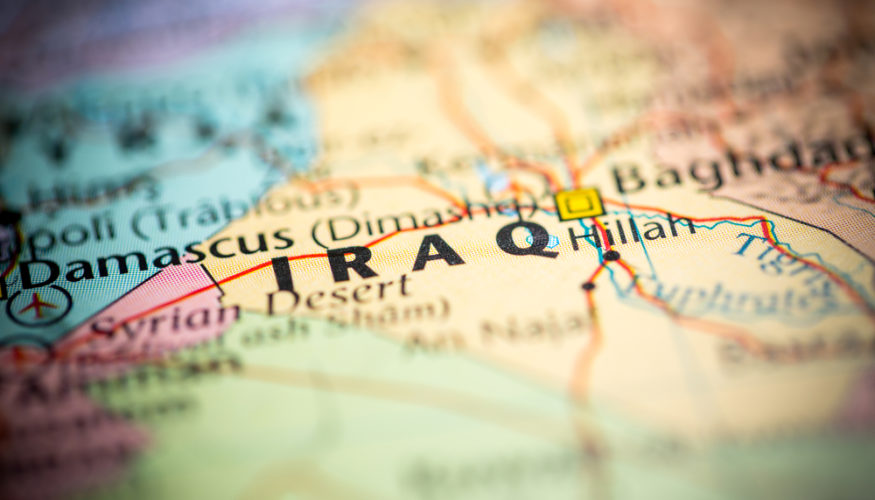
Iraq Before the Storm
(The Charlotte Observer) — A prime argument against employing military force after today’s deadline is that sanctions haven’t been given enough time to work. But considering the spotty record of previous such efforts, there’s no reason to believe that economic constraints against Iraq would ultimately succeed this time either.
Rhodesia, the renegade colony that declared independence from Britain in 1965,is a case in point. Despite the imposition of sanction, Ian Smith’s white minority government managed to get sufficient supplies through the kind of high-level horse-trading now reportedly going on between Iraq and such nations as Cuba and Romania, and along Iraqi borders with Turkey, Iran and Jordan. In fact, the availability of goods in Salisbury, Rhodesia’s capital city, closely resembled the well-stocked shelves of North Carolina’s Salisbury.
The specter of war cannot curtain smuggling to a blocked nation. It merely dramatizes the ends that nation will go to get whatever it needs. Often this hinges around personal gain. Corrupt army officers in war-torn Cambodia routinely wheeled and dealed with the Khmer Rouge guerrillas who had cut their main arteries of supply in the first place. And corrupt officials of the African "frontline states turned a blind eye to shipments destined for warring Rhodesia. As a result, good of all kinds appeared on Rhodesian shelves under disguised labels. "You can get almost anything in Rhodesia," a proud local once boasted. "If we can’t buy it, we’ll make it ourselves."
Sanctions are intended to isolate a nation psychologically as well as economically. But in Rhodesia resourcefulness, pride and patriotism filled any economic void. Stirring renditions of such ditties as "Voices of Rhodesia" (played to the tune of Beethoven’s Ninth Symphony) rallied the insular white community to the cause while government propagandists put the best possible spin on news from the front. With rare exceptions, journalists were not allowed into battle. Weakness and anxiety could not be shown. "Business as usual" was the order of the day.
Despite sanctions, hostile neighbors and a population comprised of 96 percent blacks, many middle-class whites managed to live in comfortable suburban homes staffed by servants who hand-delivered copies of the Rhodesia Herald, the buzzword-laden ("terrorists" for "guerillas, for example) newspaper of record. The Rhodesia Broadcasting Corporation wielded the "us against them" cudgel even more brazenly, conveying perceptions, for example, of ex-guerilla leader Robert Mugabe, the current president of independent, peaceful Zimbabwe, as a wild-eye, emasculated Marxist murderer.
Alan Savory, a dissident white former Rhodesian politician, once told me that 95 percent of the country’s whites didn’t have the ability to discern truth from the official government line Consequently, he explained, the "us versus them" theme to uphold the ideals of a "free," "civilized" society against the "evils of communism" never perceptibly wavered.
In keeping with this theme, Rhodesian journalists (who could not be jailed for writing about taboo subjects such as sanctions busting) sounded like cheerleaders. Some press people drank with members of the Special Branch, the secret police. A few even served on their payroll.
Compare this with what is known about the current situation in Iraq, whose population seems to march to its own version of Beethoven’s Ninth. For this we can thank the distinctive world view of the heavily controlled Iraqi media — and possibly some of our own leadership. A story alleging that U.S. troops in Saudi Arabia, where alcohol is banned, ordered beer from the Netherlands is only one example. But former Vice President Dan Quayle’s informal dress, use of his left hand and display of his shoe heel during a television meeting with Saudi King Fahd — behavior that in the Mideast is considered exceptionally boorish — could just as easily fuel fundamentalist rage against "infidels."
The cumulative effect has been to create in Iraq, as it did in Rhodesia, a siege mentality that’s zealous, self-righteous and unwavering. Factor in Saddam Hussein’s popularity with a people who only recently endorsed an eight-year war against Iran at a cost of 1 million lives. Added up, the expectation that sanctions alone will bring Hussein to kneel any time soon seems about as likely as an appearance by the tooth fairy.
The lingering effects of war and intense diplomatic maneuvering rather than sanctions finally forced the capitulation of Ian Smith some 14 years after the country’s declaration of independence. Given the hardened forces Hussein has aligned against the U.S., his nuclear potential and relentless ambition, it does not seem far fetched to assume that another 14 years of diplomatic maneuvering might be necessary to unravel the current mess. Sanctions or not, there are no easy answers. Only desperate groping, and deafening silence that precedes the storm.