Repositories of the Past
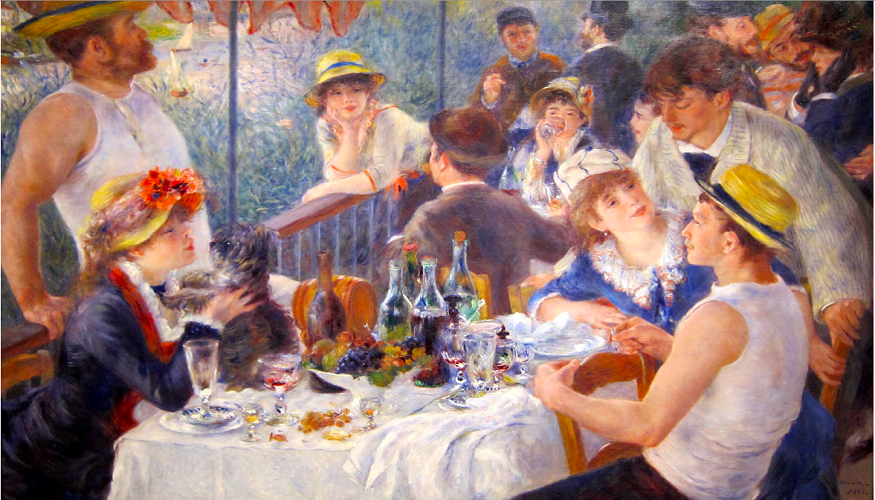
Luncheon of the Boating Party — Pierre Auguste Renoir
(The Washington Post) Mankind has showcased relics of our past since ancient times, but only in the preceding two hundred years or so has the popularity of museums and galleries begun to grow. In the U.S., Charleston, S.C. became home to the first U.S. museum in 1773. A dozen years later, artist Charles Wilson Pealed opened a museum in his Philadelphia home while in 1814 his sons, Reubens and Rembrandt, established the Baltimore Museum and Gallery of Fine Arts. By the middle of the last century, most major American cities had their own museums. Nowadays there are some 85,000 museums and galleries throughout the U.S., about 11 percent of them in the mid-Atlantic (including Washington, DC, Virginia, West Virginia, Delaware, Pennsylvania and Maryland). One DC giant, The Smithsonian Air and Space, attracts about eight million visitors annually, more than any other museum in the world.
While visitors to the District for the most part focus on the 11 Smithsonian museums (the entire complex includes 20 museums) that line the National Mall, other well-traveled parts of the region offer museums of their own. Pennsylvania, for example features 345 museums and galleries while Virginia checks in at 264; Maryland, 140; West Virginia and Delaware 49 and 15, respectively. Most are open year around. Others sponsor popular annual events such as West Virginia;’s annual Quilt Festival that draws visitors to meticulously crafted home-made garments draped across 40-foot high white marble halls. But the West Virginia State Museum is just one of countless such sites. They come to Kennett Square, Pennsylvania, mushroom capital of the world, to check out mushroom plates and mushroom bread made from some of the 38,000 mushroom varieties at Philips Mushroom Place. And to York, Pa. to visit the weightlifting Hall of Fame (the inspiration of Bob Hoffman, father of weightlifting) and the trophies and memorabilia of the Iron Game, as it is called.
Speaking of jocks, no visit to Maryland is complete without a stop at Baltimore’s Babe Ruth Birthplace/Maryland Baseball Hall of Fame Museum. The B & O Museum, also in Baltimore, features a menu from the Pullman dining car of the Royal Blue line dated March 28, 1891 which presents, among other items, lentils on shell, terrapin soup, boiled rockfish, Hygeia Water and, for four dollars a quart, G.H Extra Dry champagne. Not to be outdone, Virginia offers the Stabler-Leadbeater Apothecary Shop Museum, a recreation of an Alexandria pharmacy founded in 1792 that includes a collection of more than two-hundred hand-blown and hook-necked bottles labeled with gold leaf.
Even high brow Washington has had its share of unusual museums, including the now defunct Potato Museum. Before its closure, the Potato’s potato-style clocks, batteries, songs, stories, jokes, recipes, and postage stamps were eye candy to chidden of all ages. But many museums offer special programming that’s strictly for bonafide youngsters. Others, where "please touch" rather than "don’t touch" rules are in force, focus entirely around kids. Baltimore’s Port Discovery, the premier children’s museum in the mid-Atlantic, ranks as the second largest children’s museum in the country.
No overview of the region’s cultural landscape would be complete without mentioning military museums. During the Civil War, some of the most horrifying battles the world has known raged along the corridor between Gettysburg and Petersburg. Memorabilia associated with them is now carefully preserved in military museums throughout the region.