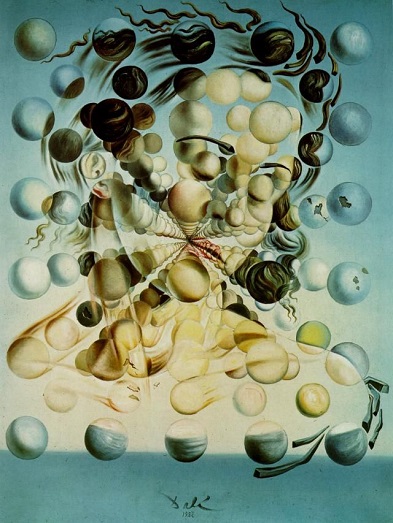
left: Salvador Dali: Galatea of the Spheres
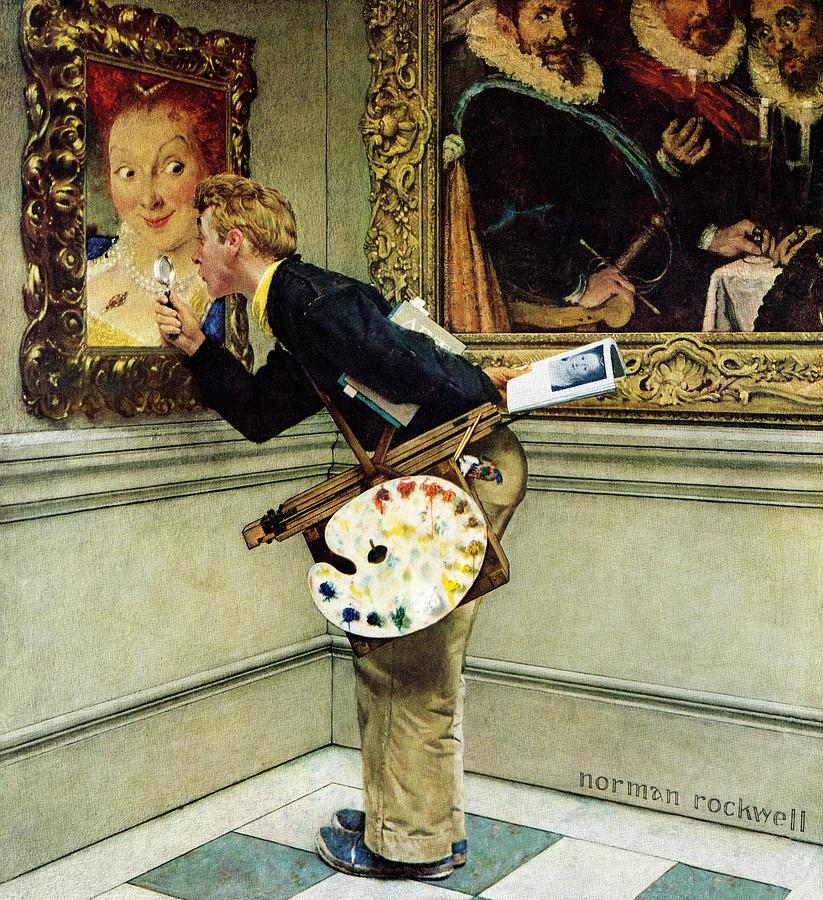
right: Norman Rockwell: Art Critic
Study in Contrasts Salvador Dali Vs. Norman Rockwell
(The Washington Post) Salvador Dali enjoyed walking his pet leopards through the world’s finest hotels, acting in seedy commercials and proudly noting that the only difference "between me and a madman is that I am not mad." His brazen antics and remarks miffed some critics, and turned others against him, probably slowing recognition of the artist as one of the 20th century’s great conceptualists and innovators.
Dali forced us to re-learn our perceptions and to redefine our vision. Even the playful image he cultivated as "a clown who paints" was a facade that dared us to look beneath the surface. Dali did precisely that. His lifelong fascination with dreams produced some of the 20th centuries most disturbing visualizations of the unconscious. He conjured up deformed, morphed images by inducing hallucinatory states in himself and then employing what he described as "paranoiac-critical." Dali (1904-1989) relied on this method to produce some of the world’s best known works of surrealism between 1929 and 1937, depicting a strong dream world that juxtaposed realistic, meticulously drawn objects within the bleak, sunlit landscapes of his Catalonian homeland. The Persistence of Memory (1931), in which limp, melting marshes rest in an eerily calm landscape, is perhaps the most famous of these enigmatic images.
Dali became famous in the 1920s as a revolutionary and iconoclastic surrealist. In the late 1930s he fell under the influence of Renaissance painter Raphael, switching to a more academic style of painting that prompted his expulsion from the Surrealist movement. As an artist, Dali was not limited to a particular style or media. He worked in oils, watercolors, and drew, drafted and sculpted. Later I his career he designed theater sets, jewelry, and the interiors of fashionable shops. At the same time exhibiting a genius for ostentatiousness, self-promotional stunts (he once appeared in a commercial guzzling Alka Seltzer) in the United States, where he lived from 1940 to 1955. From 1950 to 1970, Dali painted many works with religious themes, and explored erotic subjects. However, his most recent paintings are not as well regarded as his earlier works.
The focus of "Now, Salvador Dali," is his lesser-known preoccupation with optics and visual perception, featuring notable "double image" paintings including Apparition of Ice and Fruit Dish on a Beach (1938). The exhibition also surveys Dali’s other dreamscapes, employing such pictorial devices as elongated, oblique perspective (anamorphosis); multiple hallucinatory images (his "paranoiac-critical method") pointillism, volume blocking (stereometry)l and holograms.
Not Two Peas in a Pod
Dali shared little in common with Norman Rockwell, the devoted chronicler of American social history, who became arguably one of the most beloved artists in the U.S.
As with Dali, critics have resisted Rockwell’s work, dismissing it outright. But increasing numbers of them now praise the modest, self-styled illustrator who rarely took days off. The was perhaps because his drawings aimed, not at royalty or even important figures of the day, but "commoners" who presumably did not appreciate the nuances of art. Or maybe because of the artist’s sentimentality about American values, which contrasted with beliefs of most critics about the merits of abstraction, stylistic invention, and concept superseding subject matter and event content. Whatever the case, there has been a reassessment. Some criticism has been downright glowing. The New Yorker’s Peter Scheidahl referred to Rockwell as "a story maker, a bard," who "didn’t illustrate Middle America, he invented Middle America. Critic Dave Hickey has been even more generous, calling the artist "the last great poet of American childhood" and comparing him to 17th century Dutch master Jan Vermeer.
Rockwell distinguished his style with great attention to detail and a love of the anecdotal vignette. His most popular image, Saying Grace, shows a grandmother and her grandson bowing their heads in intense prayer before downing a restaurant meal surrounded by staring diners who look regretfully as if they haven’t prayed in years. This and many similar Rockwell images — the ones that tell the stories of ordinary people — strike a powerful chord with average Americans. Schjeidahl put it this way: "Today’s Rockwell revival signals a weariness with the raunchy horror that democracy becomes for want of spirit. By honoring such grace in the past, we ready ourselves to receive its like again."
Pictures for the America People, the first comprehensive exhibition of Rockwell’s art, opens at the Corcoran Gallery of Art June 17 and runs through September 24, exploring Rockwell’s life and work, including all 322 of his Saturday Evening Post covers. Also highlighted are the artist’s preliminary sketches, photographs, color studies and detailed drawings, spanning more than 60 years. Many of the presented works are drawn from the permanent collection of the Norman Rockwell Museum, including celebrated images such as The Four Freedoms (1943), The Marriage License (1955), Girl at Mirror (1954), The Golden Girl (1961), Going and Coming (1947) and New Kids in the Neighborhood (1967).