The Center Of The Universe
By Mike Snow, appeared in the Philadelphia Inquirer
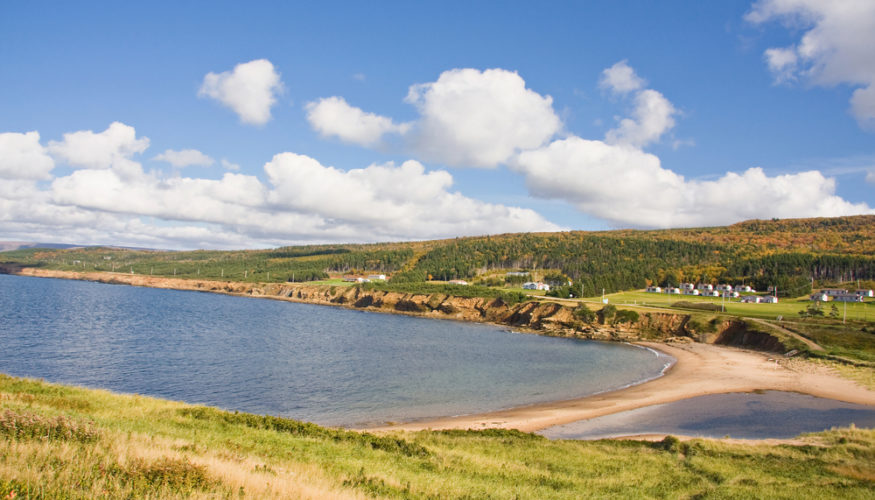
The long drive from Halifax to Cape Breton traverses rolling farmland, glacial valleys, barren headlands, mountain woods, rocky shores, and sun scorched plateaus that tower over the Atlantic. Uncompromising views in the island’s north no doubt inspired Alexander Graham Bell, who made some of his greatest discoveries there, just as they almost certainly impassioned generations of musicians whose perky tunes belie a legacy of poverty and isolation more evocative of West Virginia than New Orleans.
A curtain of gray mist that hangs over the island shrouds a lifestyle that is simple, centered and refreshingly anachronistic. Paris Hilton has no place in this world, and merely thinking about her or any dysfunctional celebrity du jour seems incomprehensible if not inappropriate. Here, the rock stars are homegrown fiddlers from 8 to 80. Or, in the case of Buddy McMaster, who’s given as much credit for rejuvenating the cape’s musical heritage as anyone, 83.
Distinguished by a mop of white hair and a vintage black suit, McMaster looked more like an old time banker than music folk hero as he hunched over a metal folding chair on the bare, makeshift stage in the barn of the 80-year-old Normaway Inn, methodically tuning his instrument as eager audience members of all ages waited for him to play.
As a child of the West nurtured on Ventura Highway and other pop classics that glamorize California free-spiritedness, fiddle music was no more my cup of tea than, say, Tchaikovsky or Beethoven. But something seemed oddly endearing about the modest venue and the unassuming onlookers, a pure contrast to big city pseudo sophisticates who, to paraphrase comedian George Carlin, buy more but enjoy less; have more experts but more problems; more medicine but less wellness; conquered outer space but not inner space. When I asked the man next to me if McMaster was the best fiddler on the cape, he affably replied: "I’d sooner swill a keg of dynamite and chase it down with a lit fuse than answer that question."
When McMaster launched into a medley of reels, clogs, jigs, and strathspeys, many fans tapped their toes and unleashed polite hoots of approval, seeming more Scottish than the Scottish, certainly not the Deliverance-like reprobates I half-expected on this remote, windswept island. It was easy to picture these earthy people hunkered down beside a crackling fire on a cold winter day, entranced by recordings of Ashley MacIsaac, the Barra MacNeils, or perhaps Maryland born David Greenberg, rather than hunting moose or bear. The persistently upbeat tunes may be an acquired taste, I decided. By the end of the evening I found myself becoming partial to the flavor.
Cape Breton possibly has more musicians per capita than anywhere. "In New York, people want to know what you do, in L.A. they want to know what you drive, but in Cape Breton they want to know what you play," said Manhattan-based Mary Cherpak, who grew up there playing the piano.
Despite the quaint, music-rich environment, and renown as the "only living Gaelic culture in North America," some visitors scorn the area as a mall-less backwater plagued by industrial decline, labor unrest and a steadily dwindling population. Take the woman surprised to find the Inverness County Centre for the Arts, "here, in the middle of nowhere."
"What she hadn’t quite grasped yet was that the ‘here’ of her question is not the middle of nowhere but is, like William Carlos Williams’ Red Wheel Barrel, the center of the universe, observed local writer Frank MacDonald. "Ask anybody who lives here."
Another common misconception is that fiddling is a cultural relic with no enduring appeal in our age of globalization. The sold out barn used for McMaster’s ceilidh (kay-lees) suggested otherwise. So did enthusiasts from around the world on tap for rousing Celtic music performances at pubs, churches, libraries and cultural centers. The frenzy peaks every October during the annual Celtic Colours International Festival, a celebration of Scottish, Acadian and First Nation heritages involving hundreds of singers, dancers, and musicians.
Cape Breton’s fiddling phenomenon is rooted in the struggles of the first European immigrants, largely Scotts, who began arriving in waves during the late 1700s. Their fiddles, bagpipes, cellos, harps and other old country instruments provided a link to the past and a way to pass the time. Family life centered around such instruments, which were proudly handed down from generation to generation. In some clans, every member learned to play.
But fiddles were always at center stage. Coal miners, fisherman and steel workers used them to celebrate everything from school openings to church fundraisers. "The music became the catalyst that kept families and communities together," said Sheldon MacInnes, who teaches at Cape Breton University. "It took away the rough edges, and provided a way to cope with life’s hardship."
Many considered fiddles magical, capable of elevating the spirits and enticing people onto dance floors. Some believed that "fairy folk" presented legendary 19th century fiddler Donald Campbell with an enchanted bow. The religious establishment took a less angelic view. One theologian called fiddle tunes "the devil’s music," MacInnis explained, noting that the church tried but failed to curb the instrument’s influence before finally embracing it.
Upper class bias against fiddles and their association with "unrefined" music, the incursion of modern technology into Cape Breton after World War II, and the emigration of young people from rural cape communities during the depressed 1950s and 1960s caused interest in the music to fade. The tradition seemed destined for obscurity until a 1972 Canadian Broadcasting System documentary, The Vanishing Cape Breton Fiddler, sparked a powerful reversal.
Today, fiddles once again are a tour de force on the cape and learning to play them is in some families a rite of passage. Locals sometimes jokingly call the instruments "violins with attitude," perhaps because their upbeat sound seems to defy often grim weather and economic conditions.
But to traditionalists like MacInnis, the instrument also represents the fierce resolve of Cape Bretonians not to let external forces — no matter how formidable — jeopardize the essence of themselves, just as the cape’s raw Nova Scotia beauty has resolutely withstood encroachment by big box franchises. It also symbolizes a sense of personal empowerment evident in even the sparsest settlements, which often sport welcome signs proclaiming fiddlers as hometown heroes.
This zealotry is particularly evident during Celtic Colours, where it’s not uncommon to see visitors singing and dancing between shows before capping well-oiled evenings at St. Anne’s College for impromptu midnight performances.
Heady supplies of beer fuel spirited but otherwise inane wee hour conversations and unspoken conviction in the power of the fairy folk and "violins with attitude" to elevate spirits to uncompromising new heights that ordinary violins — despite their Classicism — simply cannot attain; where everyone, regardless of background, becomes Scottish, or Acadian, or First Nation, or whoever he aspires to be in this oasis in time where, as the great Sufi poet Rumi might have suggested, the world converges.
The capstone for me was the riveting performance by Buddy McMaster, and the spontaneous square dancing that followed, drawing energetic participants of all ages, nationalities and skill levels. Here, in this enclave of living Gaelic culture, where the Ventura Highway intersects the Center of the universe and where the fiddling is as profound as anything by Tchaikovsky or Beethoven, no one seemed to mind when refugees from Paris got in the way.