The Imperial Art of a Regal Cereal Heiress
(The Washington Post) — Marjorie Merriweather Post is enshrined in our collective memory as a regal, fabulously wealthy cereal heiress who owned magnificent estate homes up and down the U.S. east coast. But Post’s celebrity, which even now seems to linger 27 years after her death, often overshadows the role she played as one of the foremost collectors of Russian art.
Post was the only child of a high-strung marketing genius prone to digestive ailments who came to Battle Creek, Michigan, for the Kellogg cure and ended up inventing Postum, a nutritious coffee substitute that was the precursor of Post Grape-Nuts and other popular breakfast cereals. After her father’s suicide, she oversaw the running of the Postum cereal empire. But interest in art — first French, then Russian — eventually consumed her.
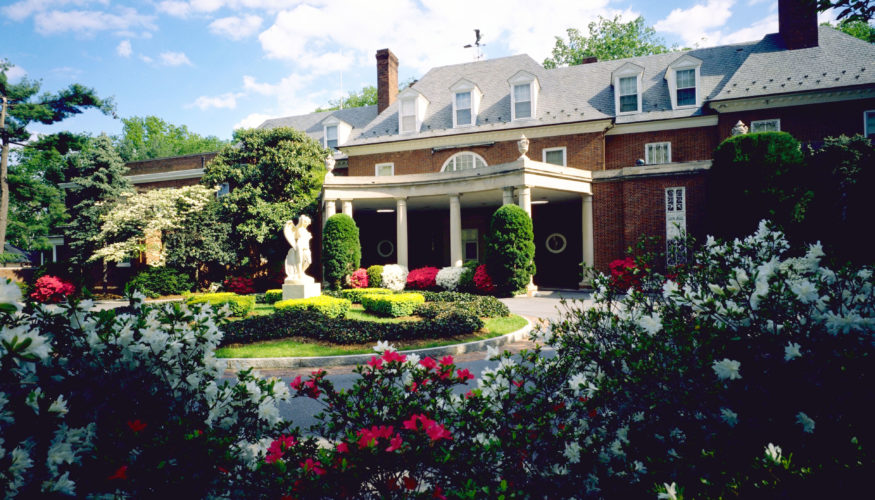
Post began collecting Russian art in 1937 at the start of an 18-month stay in Moscow as the wife of FDR’s ambassador to the Soviet Union, Joseph Davies, the third of her four husbands. She bought some of her most interesting pieces for a song in the back rooms of Russian "commission shops," accumulating about 20 percent of the collection during her stay in Moscow and the rest following her husband’s tour of duty. In her later years, she transferred the collection to Hillwood, purchased in 1955, transforming the lavish, northwest DC estate into a museum-home in the tradition of Henry du Pont, Henry C. Frick, and Isabella Stewart Gardner. The collection, which included religious icons, neoclassical objects of the late eighteenth century, and classic early twentieth century work of Carl Faberge, continued to grow. By the time of her death in 1973, Post had assembled what is perhaps the most comprehensive collection of Russian art outside Russia. "Nowhere else (outside Russia) is Russian applied art represented with such breadth and affection," according to Mikhail Piotrovskii, director of State Hermitage Museum in St. Petersburg.
A meticulous, sharp-tongued perfectionist, Post was also unpretentious and giving. "You see all these beautiful things at Hillwood and you can’t imagine the kindness and generosity of the woman who lived there," said Penne Percy Korth, U.S. Ambassador to Mauritius during the Bush Administration. "She was marvelous — to people of all statures." Party guest lists routinely included her seamstress, masseuse, hairdresser and others who worked for her. At her estate in the Adirondacks, she extended an open invitation for friends and neighbors to attend the thrice-weekly first run movies that played in her private theatre. She financed soup kitchens during the Depression, and during World War I, a mobile medical hospital. When it sank on a boat leaving New York Harbor, she unwaveringly wrote another check to fund the project all over again. And she regularly hosted Salvation Army benefits and gatherings of wounded Vietnam vets. Perhaps the most striking example of her munificence was in willing Hillwood to the public domain. Her ashes are interred in a monument of the estate rose garden. "That was her view every morning and the last thing she saw at night," said her daughter, Ellen Charles.
Nothing in Post’s background prepared her to fancy Russian art. A collector of neoclassical decorative art in the 1920s, her taste focused firmly on 18th century French furniture, porcelain and gold boxes. Yet once in Moscow she began making heavy purchases of icons and liturgical items used in rituals of the Russian Orthodox Church, following the lead of French artist Henri Matisse in 1911, one of the first Westerners to acknowledge these as "powerful examples of primitive art." Originally, such art was off limits to foreigners, but in the early 1920s the Soviet government decided to sell it to outsiders to help shore up waning foreign currency reserves, and Post and her husband were among the last buyers. While icons formed the core of her collection, porcelain impassioned her even more (as it did Europe’s eighteenth century nobility). The individual porcelain pieces that she collected, along with jewelry, textiles and furniture, account for some of the most important items in the 16,000-piece collection.
Since opening as a museum in 1977, Hillwood has attracted about 250,000 visitors. The intimacy of the grounds, near the bottom of a steep hill that leads into Rock Creek Park, plus the need to make formal reservations as long as six months in advance, have kept the museum out of the spotlight and attendance low relative to rival institutions. But an estimated 250 daily guests are rewarded with a unique museum-going experience that executive director Fred Fisher refers to as "a cultural event for which people who take the time and trouble to come here feel that they are in for something special."
- Hillwood highlights include an 1884 diamond crown worn by Empress Alexandra at her marriage to Nicholas II; about 80 works by Carl Faberge, including two imperial Easter eggs; a gold chalice with diamonds and carved stones by I.W. Buch; delicate imperial porcelain vases depicting painted scenes in a contemporary Western style; and a selection of ornate Russian Orthodox icons and religious objects.
- Among the most notable paintings at Hillwood are The Duchess of Parma and Her Daughter Isabelle (1750) by French portrait painter Jean-Marc Nattier; the monumental Portrait of Catherine II (circa 1788) attributed to Dmitrii Grigor’evich Levitskii; Portrait of Empress Eugenie (1857) by the German royal court painter Franz Xavier Winterhalter; La Nuit (1883) by renowned Parisian academic artist William Adolphe Bouguereau and Konstantin Makovskii’s A Boyar Wedding Feast (1883), which depicts the wedding of two families of the politically powerful boyar class.
During the last three years, Hillwood has undergone a $9 million renovation. Paintings have been renewed; sculptures restored, and recessed lighting installed. In addition, the refurbished museum features several important new acquisitions, including from the "Tsar’s Service" an extremely rare Vienna Du Paquier Period cup and saucer set (1730-1735), a longstanding model for the designers at the Imperial Porcelain Factory. Hillwood also acquired three elaborately embroidered miters (19th and 20th century) worn by bishops who performed the holy liturgy; a 1930s inkstand from Natalia Dan’ko’s Discussion of the Draft of the Stalin Constitution in Uzbekistan desk set; and a collection of 300 rare Russian books devoted to the history of Russian imperial decorative arts.