The City That Still Thinks It Can
By Mike Snow
“I think I can!” whispered The Little Engine That Could from the Depression‑erachildren’s classic. Today, the same gritty determination propels Cumberland, Maryland — a city once powered by steel mills and rail yards, now climbing a new summit fueled by creativity, culture, and tourism.
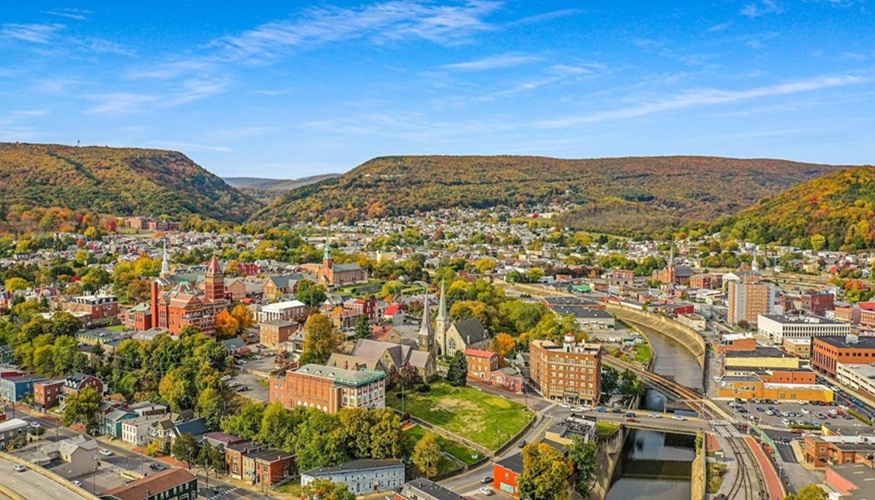
Cradled by the Allegheny Mountains and tracing the Potomac River, Cumberland’s 238‑year‑old story reaches back to George Washington’s frontier days. His modest log cabin on Greene Street — purportedly headquarters during the French and Indian War—anchors the city’s historic memory. There, in 1754, a 23‑year‑old Major Washington rallied survivors of General Edward Braddock’s bloody ambush near the supply base at Fort Cumberland, having had two horses shot from under him and four bullets rip through his coat, yet emerging unscathed to fortify defenses amid frontier chaos. On July 18, 1755, Washington wrote to his brother: “I luckily escaped without a wound, tho’ I had four Bullets through my Coat, and two Horses shot under me.”
At the junction of the Chesapeake & Ohio Canal, the Baltimore & Ohio Railroad, and the nation’s first highway, Cumberland later boomed, a gateway to the West driven by coal, iron, and timber. Church steeples pierced the skyline, factory whistles set the rhythm of life, and smokestacks signaled unending growth. The population peaked at 39,483 in 1940, with manufacturing giants like Celanese employing around 10,000 at its height.
On Saturday nights in the Roaring Twenties, workers seeking escape from long days of labor could choose from five theaters, each beckoning passersby with hand‑painted posters advertising nickelodeon films and vaudeville shows. From August 31 to September 2, 1925, the legendary illusionist Harry Houdini debuted his “3 Shows in One,” striding onstage to Pomp and Circumstance before rapt crowds at the old Maryland Theatre. Audiences gasped as Houdini—arms bound tightly behind him—was lowered upside down into a tank of water. Moments later, when he broke the surface free, cheers filled the ornate hall. Just beyond the city center, the Cumberland Race Track came alive with the roar of 20,000 spectators pushing for their favorites as they barreled down the half‑mile stretch. The city, buoyed by the industrial boom, pulsed with the energy of a miniature metropolis determined to rival Baltimore’s grandeur. Locals called it “The Queen City,” a name that spoke not only to its stature but to its sense of pride.
The Depression years dimmed that brilliance. Factory whistles fell silent, storefronts closed, and momentum seemed to drain away. Yet as war returned overseas, Cumberland’s furnaces and factories roared again, producing glass, machinery, and materials that fed the nation’s industrial hunger. Pittsburgh Plate Glass became a dominant local employer, drawing thousands back to steady work.
By mid‑century, the rhythm of the new age shifted from factory floors to fast tracks. A young Roger Penske—long before his name became synonymous with American motorsports—cut his teeth racing on the tarmac of the Cumberland airport circuit. Decades later, after more than a hundred victories and a 1995 induction into the Motorsports Hall of Fame, he would still recall the small Maryland city where it all began. In the years after World War II, the hum of Cumberland’s factories began to fade. The very policies that fueled American prosperity—the G.I. Bill’s promise of homeownership and the highway system’s gleaming new routes—also drew families and businesses away from the old downtown. Shoppers followed suburban plazas; companies followed cheaper land. By century’s end, the population had thinned by nearly 40 percent to around 19,000, with manufacturing jobs dropping from more than 15,000 in the 1950s to fewer than 5,000 by the 1990s.
Celanese trimmed its ranks year after year. Kelly‑Springfield Tire did the same, while coal production—the bedrock of western Maryland’s economy—fell below a million tons. As employment dried up, young people packed up too, chasing opportunity along the interstates that had once promised connection but now carried them away. By the 1960s, Cumberland’s per capita income had slipped below state averages. Storefronts emptied, their plate glass gathering dust; once‑proud Victorian homes lost their luster, paint peeling like forgotten promises. When Rosenbaum’s Department Store—downtown’s century‑old centerpiece, where generations bought first suits and wedding linens—locked its doors in 1971, a silence settled over Baltimore Street, broken only by the scrape of “For Lease” signs in the wind. That quiet lingered for decades, as lifelong residents watched brass elevator doors seal shut forever. The final blows landed when Celanese shuttered in 1983, laying off 2,800 workers; Kelly‑Springfield followed in 1987, its tire plant’s steam whistle falling mute as 1,200 more jobs vanished. Yet traces of that golden era endured in the brick facades and fading marquees, an echo of a time when this mountain city dreamed on a grand scale.
At the turn of the twenty‑first century, when Maryland began looking to its past to shape its future, Cumberland was ready. It was as if the city had whispered, “I think I can,” and finally begun to believe it. In 2001, the state designated the “Queen City” as one of its first official Legacy communities, unlocking grants, tax credits, and loans aimed at stitching life back into its once‑fevered downtown. Restorers peeled back false facades to reveal graceful brickwork and Art Deco details, while galleries, cafés, and small theaters filled long‑empty storefronts. Vacancy rates plunged from 60 percent to 15 percent by 2008.
A Downtown Renaissance
The transformation accelerated over two decades. A $17.2 million civic overhaul—completed with a ribbon‑cutting on November 14, 2024—upgraded waterlines, added fiber‑optic cabling, and widened the avenues with modern lighting. Curb‑less streets facilitated pedestrian flow. As of early 2026, 15 new businesses thrive downtown, with more in the pipeline.
Today, Cumberland’s downtown buzzes with creative energy. Artists’ studios spill light onto the sidewalks, heritage trails connect visitors to the city’s industrial roots, and music once again drifts from open doors on summer nights. The Queen City, long defined by reinvention, has found yet another way to honor its past by making it part of its present. On weekend mornings, Baltimore Street is alive as art galleries, cafés, and restored brick storefronts throw open their doors as cyclists and sightseers stream in from the Great Allegheny Passage, the Western Maryland Scenic Railroad, and the C&O Canal—together drawing more than 300,000 visitors a year and generating over $20 million locally, according to local officials.
Many drop by Lily’s Books on Baltimore Street, a tiny shop that exudes vintage charm. Soft jazz drifts from corner speakers as the scent of espresso mingles with the rustle of pages from books such as Stacia Stark’s We Who Will Die. Owner Martha McGill, a retired Episcopal priest, plans to host community salons and author readings by locals such as the bestselling historian Russell Shorto, who lives within walking distance.
Just a few doors away, the Ferleman Gallery blurs the line between studio and stage. Paintings of praying mantises and other majestic bugs by marine‑biologist‑turned‑artist Casey Beale hang alongside originals by Toulouse‑Lautrec, Miró, and Hilmar Gottesthal—a local artist whose work once drew admiration from Salvador Dalí, along with a dinner invitation to Dali's home in Paris.
A short walk uphill to Washington Street, the volunteer‑run Gilchrist Museum of the Arts pulses with its own creative energy. Last fall’s Anything Goes watercolor group show shared space with Kate Wharton’s whimsical Down the Rabbit Hole—an artistic deep dive into the multifaceted world of subterranean bunnies. During openings, visitors gather in the museum’s parlor, where the house bartender, known for serving Irish coffees between conversations about brushstrokes and chamber music, also serves as the museum’s grant writer.
Together, these spaces form the heartbeat of a city reinventing itself—not through grand industry, but art, conversation, and community spirit.
A Cultural and Creative Revival
Tourism in Cumberland today thrives on heritage trails and cyclists, not smokestacks. The 150‑mile Great Allegheny Passage—a car‑free ribbon of trail—links the Queen City to Pittsburgh and Washington, D.C., filling inns with trail‑weary travelers swapping stories over coffee at The Crabby Pig or Baltimore Street Grill. The Western Maryland Scenic Railroad adds an estimated $5–10 million in annual revenue, according to local tourism officials.
The city attracts both returnees and newcomers seeking to escape big‑city stress for a grounded lifestyle. More yoga mats than ever are unfurling these days at Cumberland libraries, museums, and even beneath the stained glass of some of the city’s 30 historic houses of worship—among them B’er Chayim Temple (Maryland’s oldest continuously used synagogue), a mosque, and Emmanuel Episcopal Church, where in the 1850s abolitionist rector Rev. David Hillhouse Buel sheltered escaped slaves in the church’s underground tunnels, using bell signals and quilts to guide the runaways to safety in Pennsylvania.
Cumberland’s makeover also extends to health. Allegany County, where the city sits, has long ranked as Maryland’s unhealthiest area, plagued by high rates of smoking, obesity, inactivity, substance abuse, and limited access to care. While many focus on changing the city’s appearance, others are working just as hard to transform it into a hub of wellness and renewal. Among them is Juilliard‑trained pianist Betty Hadidian, who moved here from New York 43 years ago with her late physician husband. Now nearing 100, she still plays piano every Sunday at the local Unitarian Universalist Church and teaches lessons in her sunlit living room. Christina Collins Smith launched the Be Well Festival two years ago, blending art, yoga, and holistic education, while Allegany College’s Mind‑Body program drew Elyssa Hightower and her triplets relocated from Nevada. Elite cyclist Dana Haberern, who last year bought Cycles and Things, keeps locals and trail riders in motion. And Dylon Steward’s viral recognition as Planet Fitness’s Trainer of the Year has become a symbol of Allegany County’s growing shift from health backwater to wellness leader.
In a town this size, vendors often wear more than one hat. Beale, for example, sells eggs from her flock of named pet hens to gallery patrons and at night shows on the Ferleman Gallery stage, which showcases folk, bluegrass, and roots acts like “mountain woman” Maddie Mae and folk‑punk artist Black Guy Fawkes. Around the corner, the revitalized Embassy Theatre—once a movie palace, later a drapery store—stages productions from Bonnie & Clyde to The Tina Turner Musical.Nearby, the Cumberland Theatre claimed BroadwayWorld Baltimore’s 2024 “Musical of the Year” for its presentation of Jesus Christ Superstar.
Though high‑paying jobs in Cumberland remain scarce, ambition endures. Descendants of career mill workers now launch ventures like Sitka Stage & Screen and Green Room Studios, where young actors rehearse not just lines, but lives. At Western Maryland Music, clarinets, violins, and pianos fill the air.
Some melodies refuse to fade. Unitarian Church pianist Betty Hadidian, at 99, also coaches music students from her sun‑drenched living room. Light falls across her keys like a memory, as Cumberland’s resilience plays on.
While cycling and the arts bring energy to the streets, the city’s economy remains anchored by Walmart, the local prison, the local cannabis grower, the local hospital, and the local railroad. Cumberland’s lower‑paying jobs leave many workers weary yet hopeful, buoyed by the city’s illustrious past and the dreamers and doers grounded in grit, determination, and inspiration who are intent on reconfiguring its future.
Like The Little Engine That Could, Cumberland climbs toward a new summit. The determination that once fired its furnaces now fuels cultural ascent. You hear it in the whistle of the Western Maryland Scenic Railroad, laughter from galleries and cafés, and the hum of renewal downtown. Steady, creative, and quietly sure—the Queen City whispers with conviction: I think I can.
Fascinating Facts About Cumberland, Md.
B’er Chayim Temple, built around 1865 with Gothic Revival architecture, is one of Maryland’s oldest surviving synagogue buildings and has been continuously used by the Jewish community.
Western Maryland Scenic Railroad
The railroad offers scenic rides through historic mountain tunnels previously used by coal trains, highlighting Cumberland’s rail heritage.
Fort Cumberland (1754)
This frontier outpost was a key site during the French and Indian War; figures like George Washington (not Daniel Boone or Thomas Jefferson directly) were involved, though Jefferson later referenced the area.
Allegany Museum
The museum displays artifacts tied to the National Road, America’s first federal highway, which originated near Cumberland.
Great Allegheny Passage
The trailhead in Cumberland attracts tens of thousands of cyclists annually on this popular rail-trail from D.C. to Pittsburgh (exact 150,000+ figure unconfirmed but plausible for the network).