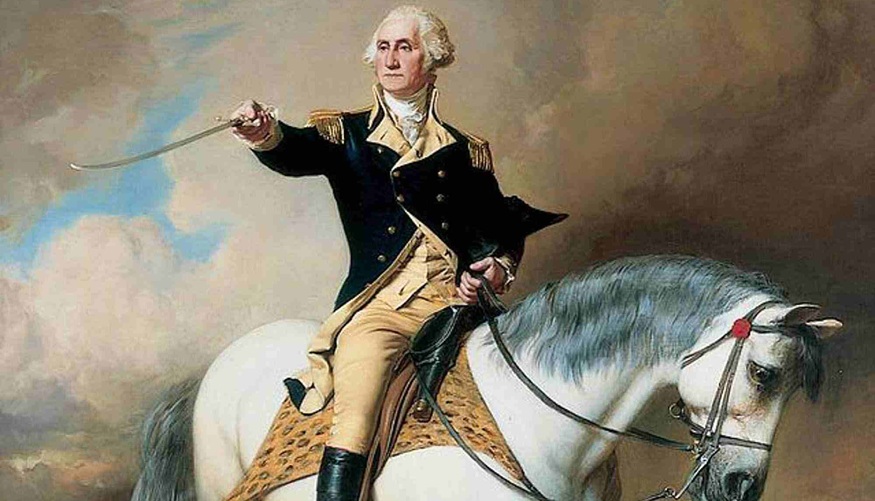
The Man Who Would Not Be King: George Washington and the American Republic
In Allegany County—where history feels close enough to touch—it is easy to think of George Washington as an iconic figure, a flawless hero so revered that he became renowned as “the father of our country.” But few Americans know that Washington was, in many ways, far different from what they imagine. He was not born a great leader; this was a role he struggled mightily to grow into, beginning as a boy growing up in Virginia.
In fact, Washington spent much of his life trying to overcome his shortcomings and improve himself. What we now see as calm leadership was, in reality, the result of a determined effort to master his personal flaws. His story is not just about founding a nation, but about building the kind of character that made that founding possible. Over six feet tall, Washington was ambitious, often hot-tempered, and unafraid of confrontation. Those traits could easily have defined him—and limited him. Instead, he chose to reshape them.
One of his earliest tools was a handwritten copy of The Rules of Civility, a guide to proper conduct that he studied as a teenager. Its lessons—restraint, respect, self-control—did not come naturally to young George. They were practiced. Over time, they became part of the public image he presented to the world.
That discipline proved critical during the Revolutionary War. Washington was not known for dazzling battlefield victories; his real strength was persistence. He understood that the Continental Army did not need to defeat Britain outright; it needed to survive long enough to make the war too costly to continue. At key moments, he showed a willingness to take calculated risks invaluable to the new nation. His crossing of the Delaware in 1776 is the most famous example, a bold move that revived American morale. Less well known—but just as important—was his decision to order widespread smallpox inoculation of his troops. The disease posed a greater threat than the British army, and Washington chose prevention despite the dangers involved. It was such practical, forward-thinking decisions that helped keep his army intact.
Still, Washington was never the flawless figure that later generations imagined. He enjoyed the lifestyle of a Virginia gentleman, including gambling, horse racing, and the careful management of his growing estate at Mount Vernon. Financial success mattered to him, and he pursued it with determination. His personal life also was not without complexity. His marriage to Martha Washington lasted 40 years, though they had no children together. At the same time, his close friendship with Sally Fairfax, the wife of Washington’s close friend, neighbor, and mentor, is widely regarded by historians as Washington’s first great love and a pivotal intellectual influence during his formative years—an emotional depth that does not fit neatly into the traditional story.
Even his reputation for honesty was, in part, something he cultivated. The well-known cherry tree story was invented after his death, but the larger idea—that Washington valued truthfulness—was real. He understood that trust would be essential in a new and uncertain nation. His integrity was not accidental; it was intentional.
Physical hardship also shaped how others viewed him. Washington suffered for years from severe dental problems, relying on uncomfortable dentures made of hippopotamus ivory, gold, brass, and human teeth that affected both his speech and his expression. The composed, unsmiling face we associate with him was partly the result of that discomfort. What appeared to be natural dignity was, in truth, something he maintained through constant effort.
The biggest contradiction in Washington’s life was his connection to slavery. A lifelong owner of slaves, he spoke of liberty and led a revolution built on that ideal. Yet during his presidency, he approved efforts to recapture slaves of his own who escaped. Over time, Washington’s views appear to have shifted. The experience of the Revolution—and the contributions of Black soldiers—seem to have influenced his thinking. In his will, Washington arranged for the emancipation of the slaves he personally owned, setting himself apart from many of his contemporaries. It was a meaningful step, though it did not resolve the larger contradiction. Like the country he helped found, Washington’s legacy on this issue remains complicated.
If there is one moment that defines his character, it is not found on the battlefield but in what he chose not to do.After the war, when there was real concern that the new nation might collapse into instability, some suggested that Washington should become king of the fledgling country. He rejected the idea outright. Later, after serving two terms as president, he stepped down voluntarily, even though he could have remained in power. These choices were not inevitable. In many parts of the world, revolutions had led to strongmen and lifelong rulers. Washington set a different example. By giving up power—twice—he made it clear that leadership in the United States would belong to the office, not the individual. That decision helped shape the political culture of the country in ways that are still felt today.
Washington died in 1799, leaving behind a young nation still searching for its footing. What he offered was not perfection, but consistency—a steady effort to rise above his own flaws in service of something larger. He was ambitious, but learned restraint. He sought success, but accepted its limitations. He held power, but chose to relinquish it. Washington rejected the idea of kingship with "abhorrence," calling it a potential "mischief" to the country. His legacy is not just that he helped create a republic. It is that he understood what that republic required—and worked, over a lifetime, to achieve it. He was the man who would not be king.
(Note: While Washington’s use of federal troops to suppress the Whiskey Rebellion in 1794 drew accusations of monarchial overreach from his critics, the event occurred during his presidency, firmly establishing his commitment to the rule of law before he voluntarily left office in 1797.)